 blog
blog
Is EPDM Roofing Suitable for Flat Roofs? A 2026 Guide
Table of Contents
- Is EPDM Roofing Suitable for Flat Roofs?
- EPDM Roofing Pros and Cons
- EPDM vs Fibreglass Flat Roof: Which Wins?
- How Long Does EPDM Roofing Last?
- EPDM Roof Maintenance: What You Actually Need to Do
- Building Regulations, Fire Performance and Warranty Requirements
- Which Flat Roofs Suit EPDM Best?
- Frequently Asked Questions
Last Updated: October 12, 2026
Is EPDM Roofing Suitable for Flat Roofs?
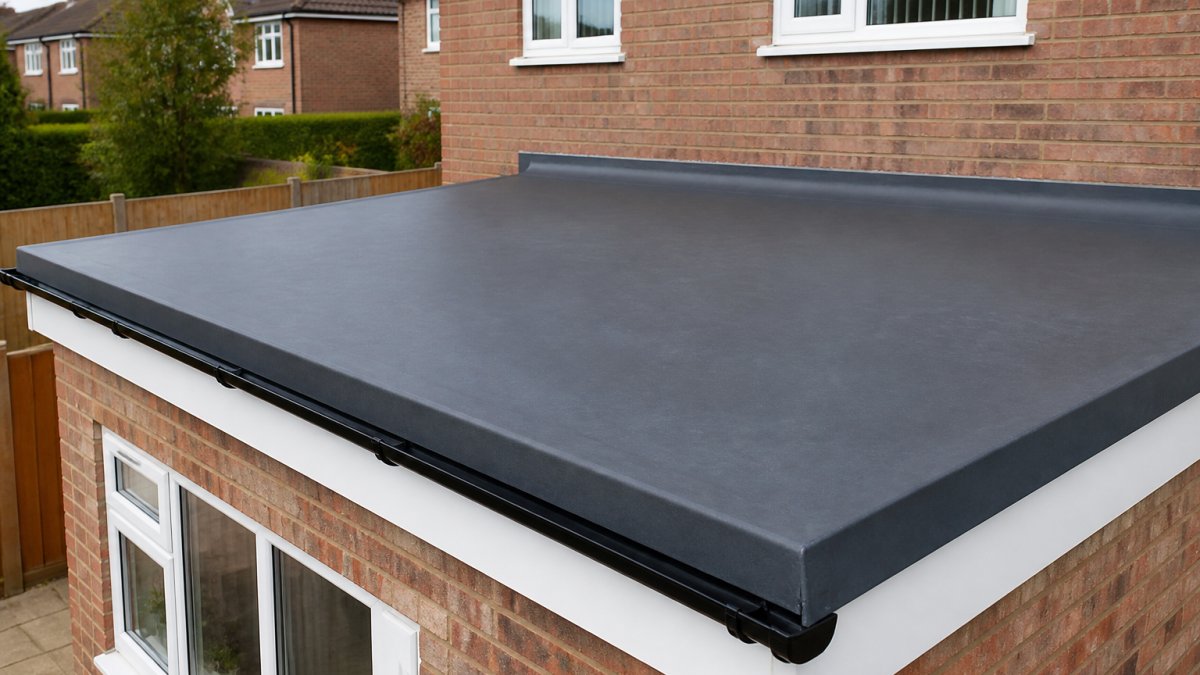
EPDM roofing is a synthetic rubber membrane that has become one of the most trusted flat roofing systems for domestic and commercial properties. For most flat roofs, the answer is yes: EPDM is suitable, durable, and well suited to the British climate. This guide from ARRC Ltd explains where it works best, where it falls short, and how it compares with felt and fibreglass.
The material itself is straightforward. EPDM (ethylene propylene diene monomer) is a single-ply rubber membrane supplied in large sheets, typically 1.1mm to 1.5mm thick, that is glued or mechanically fixed over a prepared roof deck. Because it arrives in wide sheets, a typical garage or extension roof can often be covered with few or no seams.
That matters more than it sounds. Seams and joints are where most flat roof failures begin. Fewer seams mean fewer weak points, and that is the core reason EPDM has earned its reputation.
British Standards Institution guidance on roofing membranes
EPDM Roofing Pros and Cons
EPDM's strengths are weather resistance, flexibility, and a long service life. Its weaknesses are the quality of the substrate beneath it and the skill of the installer.
Pros:
- Excellent UV and weather resistance, so it handles frost, rain, and summer heat without cracking
- Stays flexible in cold weather, which reduces the risk of splits during winter
- Large sheets mean fewer seams and joints
- Resists punctures from general wear and tear better than many alternatives
- Low maintenance once installed correctly
Cons:
- It is not a walkable surface in the way some finishes are, and sharp objects can still cause damage
- Adhesive and seam tape must be applied correctly, or seams can fail
- It will not fix poor drainage; ponding water needs addressing at the roof deck, not the membrane
- Dark membranes absorb heat, though lighter colours are available
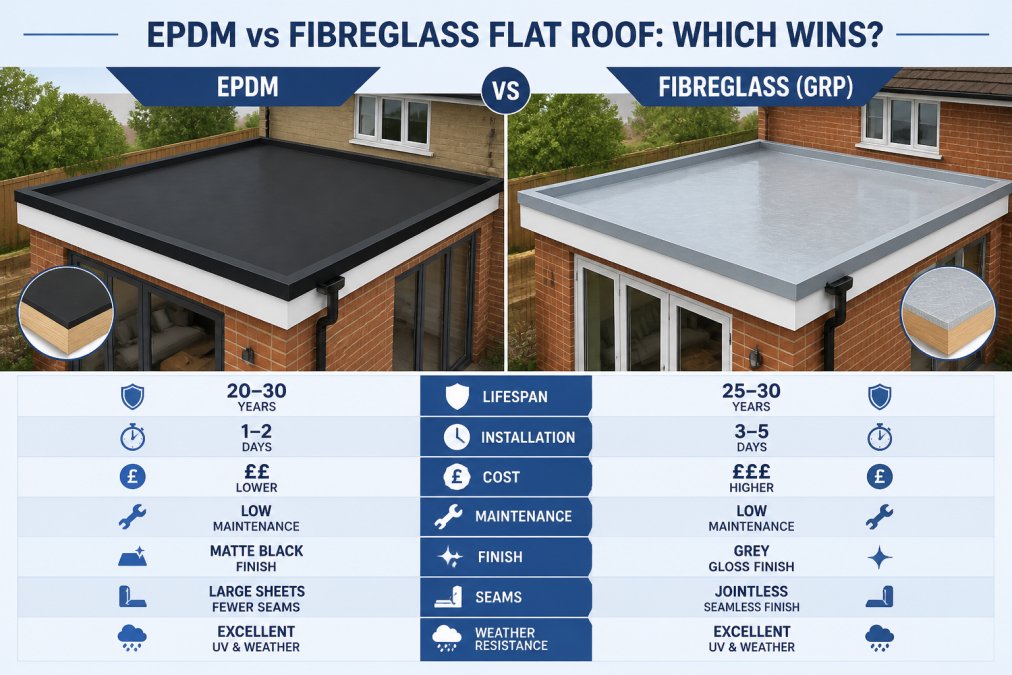
EPDM vs Fibreglass Flat Roof: Which Wins?
Fibreglass, more accurately called GRP (glass-reinforced plastic), is a liquid resin system applied over a chopped-strand matting layer, forming a rigid seamless shell once cured. EPDM arrives as a pre-formed rubber sheet.
Where EPDM wins:
- Large, simple roofs. A typical garage or extension roof can be covered with a single sheet, so there are almost no seams to fail. GRP is applied in stages and is more sensitive to weather during curing.
- Thermal movement. EPDM stays flexible down to around -40°C and tolerates the expansion and contraction of a timber deck without cracking. GRP is rigid and can crack where the substrate moves.
- Speed of installation. A competent two-person team can fit an EPDM membrane on a standard garage roof in a day. GRP typically takes two to three days because of the layering and curing stages.
- Repairability. A puncture in EPDM can be patched with a bonded patch in minutes. GRP repairs require grinding back and re-laminating, which is messier and more visible.
Where fibreglass wins:
- Walkable roofs and balconies. GRP takes foot traffic far better than EPDM, which can be scuffed or punctured by regular use.
- Complex detailing. Around multiple penetrations, awkward corners and small dormers, GRP can be formed seamlessly on site, whereas EPDM relies on pre-formed corners and patches.
- Colour and finish. GRP can be finished in a wide range of colours with a durable topcoat. EPDM is available in black, grey and white, but the palette is limited.
- Aesthetics on visible roofs. A GRP roof can be finished to look like a traditional lead or felt roof; EPDM looks like rubber.
| Feature | EPDM Rubber | Fibreglass (GRP) |
|---|---|---|
| Flexibility | High, stays pliable in cold | Rigid |
| Seams | Few, from large sheets | Seamless |
| Best for | Garages, extensions, large flat roofs | Balconies, walkable roofs, complex shapes |
| Installation speed | Fast on simple roofs | Slower, multi-stage |
| Movement tolerance | Good | More prone to cracking |
| Walkability | Limited | Good |
| Repair ease | Simple bonded patches | Grinding and re-laminating |
| Typical lifespan | 20-30 years | 20-30 years |
Lifecycle cost, not just upfront cost. The two systems are often quoted within a similar range for a standard garage roof, but the total cost of ownership diverges over time. EPDM has lower maintenance demands and cheaper repairs, so its 25-year cost tends to be lower on simple roofs.
A practical decision rule:
- Simple, low-traffic roof (garage, extension, shed, commercial unit) → EPDM
- Walkable or regularly trafficked roof (balcony, terrace, roof garden) → GRP
- Roof with many penetrations or awkward geometry → GRP
- Roof where speed and minimal disruption matter → EPDM
- Roof with existing ponding or poor falls → fix the deck first, then choose either
For a garage or extension with a straightforward shape, we would choose EPDM. For a balcony or a roof you need to walk on regularly, fibreglass often edges ahead. If your roof sits between the two, the deciding factor is usually how much foot traffic it will see and how complex the detailing is.
How Long Does EPDM Roofing Last?
A well-installed EPDM roof commonly lasts 20 to 30 years, and often longer when the substrate and drainage are correct. The membrane itself is rarely the limiting factor. Installation quality, roof preparation, and drainage decide how long it actually lasts.
That is why our flat rubber roofs at ARRC Ltd carry a 20-year guarantee. The guarantee reflects both the material and, just as importantly, the workmanship behind it.
UK government guidance on roof maintenance and building safety
EPDM Roof Maintenance: What You Actually Need to Do
EPDM roof maintenance is minimal compared with felt or older bitumen systems, but it is not zero. A little attention twice a year keeps a rubber roof in good condition for decades.
- Clear leaves and debris from roof outlets and gulleys, especially before winter
- Check for ponding water after heavy rain and investigate any that lingers
- Inspect seams, joints, and flashing around edges, skylights, and outlets
- Remove sharp objects or anything abrasive that could puncture the membrane
- Watch for blistering or lifting, which usually signals trapped moisture below
Building Regulations, Fire Performance and Warranty Requirements
Flat roof work is not a case of laying a membrane and walking away. In most cases, replacing or recovering a flat roof is controlled work under the Building Regulations 2010 (as amended), and the roof assembly, not just the EPDM sheet, has to satisfy the relevant functional requirements. For a domestic garage or extension, that usually means demonstrating compliance with:
- Part B (Fire safety), the external fire exposure performance of the roof covering and, where relevant, the fire resistance of the roof structure
- Part C (Site preparation and resistance to contaminants and moisture), weathertightness and resistance to interstitial condensation
- Part L (Conservation of fuel and power), thermal performance of the roof build-up where the roof is being replaced or upgraded
- Part K (Protection from falling), relevant where the roof is accessible or where work is carried out near edges
On fire performance specifically, EPDM membranes are tested to BS EN 13501-5 and classified under the BROOF(t4) system, which is the classification most commonly required for roof coverings on buildings subject to the Building Regulations. A compliant EPDM system should come with a valid test report and a classification certificate from the manufacturer. If an installer cannot produce that documentation, the roof may not satisfy building control, and it may also invalidate your insurance.
For most domestic flat roof replacements, the work is notifiable and should be signed off either by your local authority building control team or by a registered competent person scheme. You should receive a completion certificate. Keep it, it matters when you sell the property, and it is often the first thing a buyer's solicitor asks for.
HM Government Approved Document B (Fire safety)
LABC guidance on building control and flat roofing
Warranty is the other half of the compliance picture, and it is where cheap quotes quietly fall down. A meaningful EPDM guarantee should cover three separate things:
- The membrane itself, typically 20 to 30 years against manufacturing defects, backed by the membrane manufacturer rather than the installer alone
- The adhesive, seam tape and accessories, these are the components most likely to fail first, so they should be named in the guarantee
- Workmanship, usually 10 to 20 years, and the part most installers try to exclude
Ask any contractor for the manufacturer's system warranty in writing, and check whether it is conditional on using the full approved system (membrane, adhesive, primer, tape and edge trims from the same manufacturer). A guarantee that only covers the rubber sheet and excludes the seams is close to worthless, because seams are where failures actually happen.
Which Flat Roofs Suit EPDM Best?
EPDM suits most flat roofs, but it performs best on simple, well-drained, low-traffic roofs. The table below shows where it fits.
| Roof Type | Suitability | Notes |
|---|---|---|
| Garage roofs | Excellent | Simple shape, few seams |
| Extensions | Excellent | Fast, low-maintenance |
| Dormers | Very good | Flexible around awkward shapes |
| Bay windows | Very good | Handles small, detailed areas |
| Commercial units | Excellent | Durable, minimal upkeep |
| Balconies | Fair | Fibreglass often better |
| Walkable roofs | Fair | Consider GRP instead |
If your roof has standing water, the fix is not a thicker membrane. It is correcting the roof fall and drainage so water moves to the outlets. EPDM will not compensate for a roof that holds water.
Flat roofs fail for predictable reasons: poor preparation, trapped moisture, and seams done badly. Getting those right is what separates a roof that lasts 20 years from one that leaks within two. At ARRC Ltd, we bring over 30 years of experience to every EPDM installation, use high-quality materials, and back our flat rubber roofs with a 20-year guarantee covering both membrane and workmanship. If you need a flat roof replacement for a garage, extension, or commercial unit, get a quote from ARRC Ltd and have it done properly the first time.
Frequently Asked Questions
Is EPDM roofing suitable for flat roofs?
Yes. EPDM is one of the most suitable materials for flat roofs because it is a single-ply rubber membrane supplied in large sheets, which means fewer seams and less chance of water getting in. It handles standing water, UV exposure and temperature swings well. For garages, extensions, bay windows and commercial units, EPDM roofing delivers reliable performance when installed correctly over a sound roof deck.
What are the disadvantages of EPDM roofing?
EPDM has a few drawbacks worth knowing. It is not the cheapest option upfront, and it is not the best choice for walkable roof terraces unless a protective walkway is fitted. Sharp objects and dropped tools can puncture the membrane, and poor installation at seams, edges or outlets causes most failures. It also requires a reasonably smooth, dry substrate, so a badly damaged roof deck needs repair before the rubber goes down.
How long does EPDM roofing last?
A well-installed EPDM flat roof typically lasts 20 to 30 years, and some systems carry manufacturer warranties of 20 years or more. Lifespan depends heavily on installation quality, correct substrate preparation and whether the roof has adequate fall for drainage. ARRC Ltd backs its flat rubber roofs with a 20-year guarantee, covering workmanship and materials when the installation meets the required standards.
Is EPDM better than fibreglass for a flat roof?
EPDM and fibreglass both work well on flat roofs, but they suit different situations. EPDM is flexible, quick to install and handles building movement without cracking. Fibreglass is rigid, seamless and often chosen for walkable areas or complex shapes. For most domestic flat roofs, EPDM offers a strong balance of durability, low maintenance and value. The right choice depends on roof size, access and how the roof will be used.