 how-to
Can You Install EPDM Over Wet Felt? The Honest Answer
Last Updated: November 2, 2026
Quick Summary
No, you should not install epdm over wet felt. EPDM is a vapour barrier, so any moisture trapped in the old felt has nowhere to escape and will blister, weaken the adhesive bond and rot the deck. The felt must be dry through its full depth, verified with a moisture meter, before any overlay.
- Damp felt must dry through its full depth before an overlay, which can take far longer than the surface suggests.
- Moisture readings that stay high or climb without rain point to moisture trapped in the deck, so plan to strip off.
- Cleaning a roof and laying membrane the same afternoon is one of the most common causes of adhesion failure.
- Working outside the adhesive manufacturer's moisture and temperature limits voids the system warranty.
- A fleece-backed membrane can act as a separation layer between aged bitumen and the rubber.
Table of Contents
- The Short Answer: EPDM Over Wet Felt Is a Risk You Should Not Take
- Why Wet Felt Traps Moisture and Breaks Down the Bond
- Conditions That Make an Overlay Suitable and When to Strip Off
- How to Prepare a Roof Deck for EPDM: Step-by-Step
- Moisture and Weather Readiness Checklist Before You Lay EPDM
- The Cost of Stripping an Old Felt Roof and Why It Can Be Worth It
- Compatibility, Fleece-Backed Membranes and Separation Layers
- Book a Flat Roof Inspection Before You Decide
- Frequently Asked Questions
The Short Answer: EPDM Over Wet Felt Is a Risk You Should Not Take
Can you install EPDM over wet felt? No. Not safely, and not in a way any reputable installer would guarantee.
Here is the part most guides skip: the problem is not the felt itself. It is the water held inside it.
Trapped moisture has nowhere to go once a rubber membrane is laid on top. It sits against the old bitumen, works its way into the bond, and waits.
Below, we break down the conditions that make an overlay suitable, the preparation steps that matter, and when stripping the old felt is the only honest option. For the practical method, see how to install EPDM over an existing felt roof.
Why Wet Felt Traps Moisture and Breaks Down the Bond
An EPDM membrane is a vapour barrier. That is exactly why it keeps rain out, and exactly why it must never be laid over a damp substrate.
Any moisture left in the old felt has two escape routes once the rubber goes down: none. It stays put. As temperatures rise, that moisture turns to vapour and expands.
What Happens to Adhesive and Membrane When Moisture Is Trapped
Contact adhesives used to bond EPDM to a substrate need a dry, sound surface to grip. Water vapour attacks that bond from underneath.
The result is a gradual loss of adhesion. The membrane lifts in patches, and the felt beneath can soften and rot. According to the Rubber Roofing Association's guidance on EPDM installation, correct substrate preparation is central to any bonded membrane system.
Blisters, Seam Failure and the Leaks That Follow
Bubbles are the visible warning sign. Learn more in our guide to preventing flat roof bubbling in hot weather. A blister is trapped vapour pushing the membrane away from the deck.
Seams fail first because they are the weakest point. Then water gets in, and the leak you thought you had fixed returns. See our advice on preventing flat roof leaks after repair.
Conditions That Make an Overlay Suitable and When to Strip Off
An overlay can work, but only on a narrow set of roofs. The felt must be dry through its full depth, firmly bonded, and free of soft spots.
Most old felt roofs fail at least one of those tests. When they do, stripping off is the correct call.
The word that decides most of these cases is "wet", and it is used loosely. Three different situations get called wet felt, and they do not carry the same risk:
- Damp felt. The felt has absorbed moisture and reads high on a moisture meter, but there is no standing water and no active leak. This is the most common case after a run of wet weather. It is not suitable for an overlay until it has dried, and drying through the full depth of old felt can take considerably longer than the surface suggests.
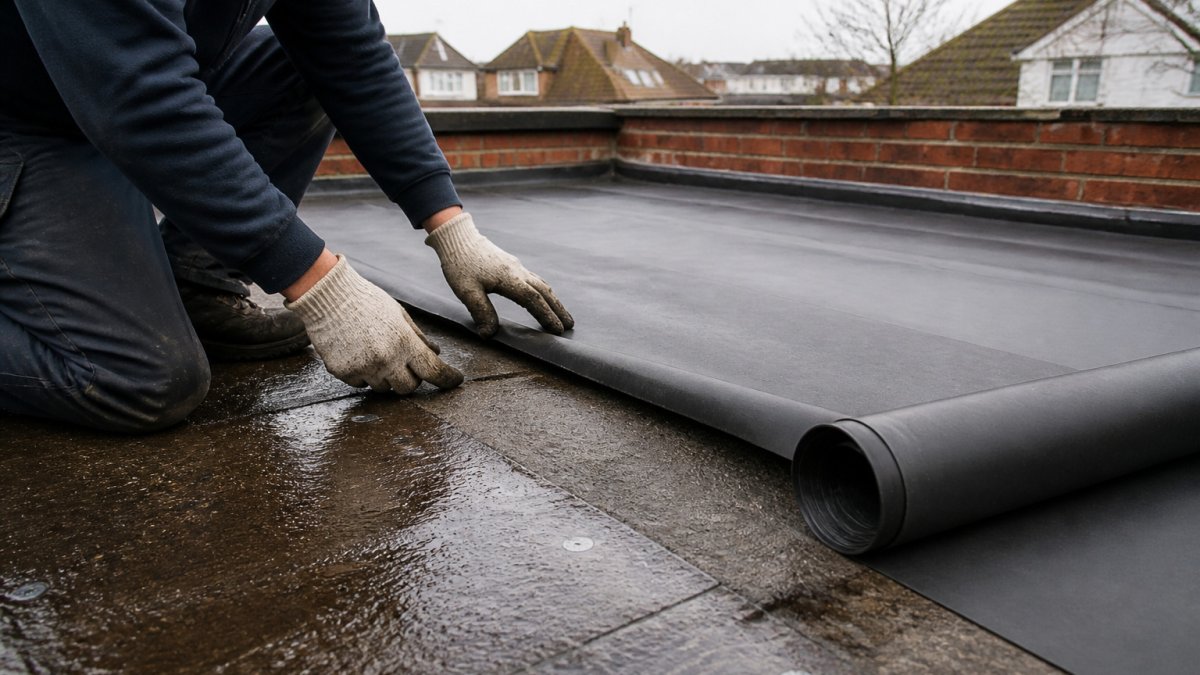
- A wet roof surface. Rain or dew is sitting on top of the felt. This is a short-term condition. Once the surface is cleared and the felt has dried, the roof may be perfectly suitable, provided the felt itself is sound.
- Moisture trapped underneath. Water has entered the deck or the insulation and cannot escape. This is the serious case. No amount of surface drying will fix it, and an overlay will seal it in. If a moisture meter reads high across a wide area, or readings do not fall after dry weather, assume trapped moisture and plan to strip off.
A direct comparison helps here. See whether EPDM rubber is better than felt for flat roofs.
What Happens If You Overlay Wet Felt Anyway
It is worth being clear about the consequences, because they are not guaranteed but they are predictable. The likely failure modes are:
- Poor adhesion. Contact adhesives need a dry substrate to grip. Moisture at the bond line weakens the grip from day one, and the membrane lifts in patches.
- Blistering. As temperatures rise, moisture in the felt turns to vapour and expands. Because EPDM is a vapour barrier, the vapour has nowhere to go and pushes the membrane away from the deck.
- Trapped moisture and decay. Water held against the old bitumen and the deck keeps the timber damp. Soft patches spread, and the deck deteriorates under a roof that still looks intact from above.
These are risks rather than certainties. A roof might survive a season or two. But no reputable installer will guarantee a bonded membrane over a substrate that was wet at the time of installation, and a guarantee is only worth what the substrate underneath it is worth.
A Simple Overlay or Strip-Off Decision Tree
Work through these in order. Stop at the first "no".
- Is the felt fully dry through its depth, checked with a moisture meter at multiple points?
- Have readings stayed low after a spell of dry weather, ruling out trapped moisture?
- Is every section firmly bonded, with no loose or spongy areas?
Six ticks means an overlay is worth pricing. Any single failure means strip off. If you are unsure which of the three wet-felt situations you are looking at, that uncertainty is itself a reason to strip off rather than gamble on a bond.
Three different situations get called wet felt, and they do not carry the same risk.
| Situation | What it means | Overlay suitable? |
|---|---|---|
| Damp felt | Felt has absorbed moisture, no standing water or active leak | No, until it has dried |
| A wet roof surface | Rain or dew sitting on top of the felt | May be, once surface is cleared and felt dried |
| Moisture trapped underneath | Water has entered the deck or insulation and cannot escape | No, plan to strip off |
How to Prepare a Roof Deck for EPDM: Step-by-Step
Preparation decides whether the roof lasts. Knowing how to prepare a roof deck for EPDM properly is the difference between a 20-year membrane and a call-back in eighteen months.
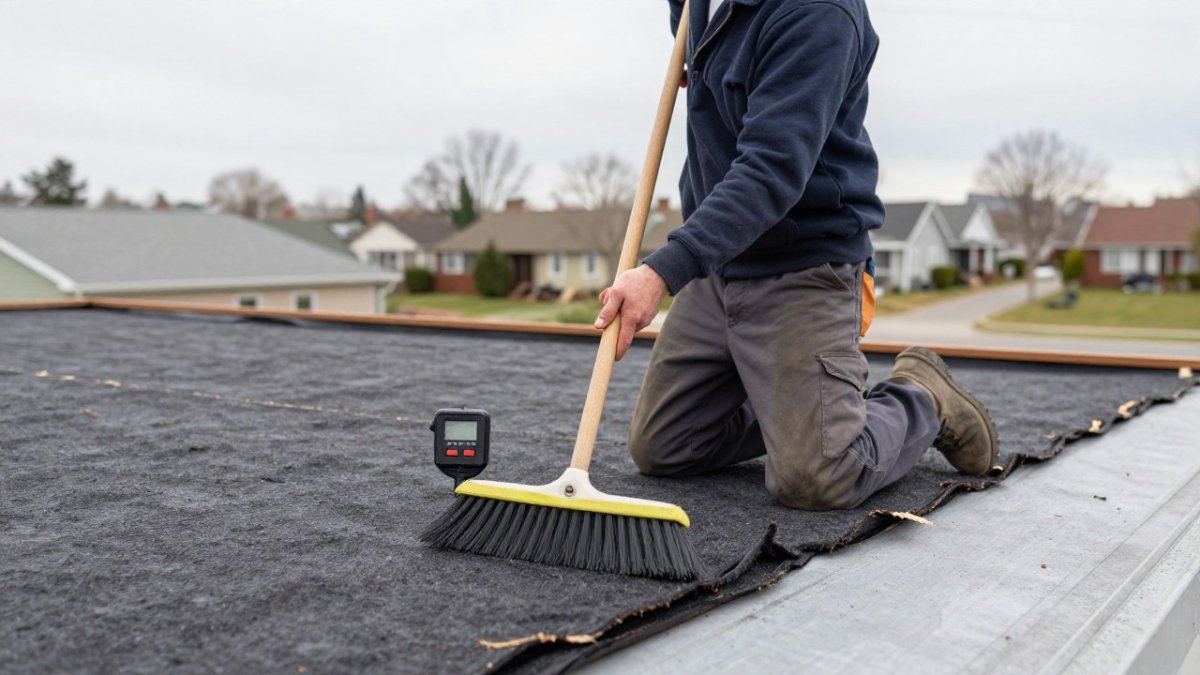
Inspecting the Existing Felt and Roof Deck
Start by walking the roof. Press down across the whole surface and note any soft spots. Check the felt condition at upstands, outlets and seams, where damage shows first.
Look for loose felt, splits, and any sign of damp in the deck below. A moisture meter gives you a reading rather than a guess.
Cleaning, Repairing and Checking Dryness
- Clear the roof. Remove debris, moss and standing water.
- Clean the surface. Scrub off surface contamination so the adhesive can bond.
- Repair defects. Patch splits and re-fix any loose felt edges.
- Check dryness. Take moisture readings across the deck and record them.
- Confirm the weather. Dry, mild conditions are needed for adhesive work.
Watch out: cleaning a roof and then laying membrane the same afternoon, before the felt has dried out, is one of the most common causes of adhesion failure we see.
Moisture and Weather Readiness Checklist Before You Lay EPDM
Dry means dry through the full depth of the felt, not just dry to the touch. Surface dryness tells you very little, and a roof that feels dry underfoot can still hold enough moisture to ruin a bond.
Use this checklist before any membrane goes down:
- Moisture meter readings taken at multiple points across the roof, all within acceptable limits
- Readings repeated after a dry spell to confirm they are falling, not just low on one visit
- No rain forecast for the installation window
If any box is unticked, delay. A day's wait costs far less than a failed bond.
Confirming the Felt Is Dry Enough After Rain
A moisture meter gives you a reading rather than a guess, but the reading only means something if you know how to use it.
Drying time depends on conditions, and there is no single number that fits every roof.
Watch out: cleaning a roof and then laying membrane the same afternoon, before the felt has dried out, is one of the most common causes of adhesion failure we see.
What to Do If Conditions Are Borderline
If readings are close to the limit, or the forecast is uncertain, the honest answer is to wait. Adhesive manufacturers set temperature and moisture limits for a reason, and working outside them voids the warranty on the system even if the bond appears to hold at first. If the installation window is tight and the roof will not dry in time, that is a signal to reconsider the method rather than to push ahead.
The Cost of Stripping an Old Felt Roof and Why It Can Be Worth It
Pricing depends on quantity, dates, and delivery, so please contact ARRC Ltd or visit our website for current prices or a quote.
A strip-off lets us inspect the deck, replace any soft timber, and install the new membrane onto a sound, dry substrate.
Our flat rubber roofs carry a 20-year guarantee.
Compatibility, Fleece-Backed Membranes and Separation Layers
EPDM and bitumen behave differently. Some adhesive systems do not bond well to aged bitumen, and fresh bitumen can affect certain membranes.
A fleece-backed membrane can help with this by acting as a separation layer between the old surface and the rubber.
Not every system needs one. Check the membrane manufacturer's installation instructions and confirm compatibility with bitumen before you buy.
Book a Flat Roof Inspection Before You Decide
The wet-felt question cannot be answered from a photograph or a phone call. It needs someone on the roof with a moisture meter.
If you are in Staffordshire, Cheshire or Stockport and unsure whether your roof can be overlaid, read about our flat roofing contracting services and get in touch for a quote.
At ARRC Ltd, we bring over 30 years of experience, use high-quality materials, and back our flat rubber roofs with a 20-year guarantee. We also handle fascias and soffits.
Get started with ARRC Ltd and get a quote for your roof.
Frequently Asked Questions
Why is it dangerous to install EPDM over wet felt?
Wet felt traps moisture between the old roof covering and the new EPDM membrane. As temperatures rise, that moisture turns to vapour and pushes against the adhesive, causing blisters, loose patches and seam failure. The bond cannot form properly on a damp surface, so even a small damp patch can lead to leaks within a season. Always confirm the felt is fully dry before any EPDM overlay work begins.
Can you lay rubber roofing over old felt if it is dry?
Yes, in the right conditions. The existing felt must be sound, well adhered, free of splits and blisters, and completely dry. The surface needs cleaning, and any loose areas should be cut out and repaired. A fleece-backed membrane or separation layer is often used to isolate the new EPDM from the bitumen in the old felt. Check the membrane manufacturer's installation instructions and warranty terms before starting.
What happens if moisture is trapped under an EPDM roof?
Trapped moisture causes adhesive failure, bubbling and seam separation. In cold weather it can freeze and expand, stressing the membrane from below. Over time the roof deck itself may start to rot, especially timber substrates, and insulation performance drops. By the time leaks appear inside the property, the damage underneath is usually more extensive than the visible problem.
Do I need to strip my old felt roof before installing EPDM?
Not always, but often. If the felt is dry, firmly bonded and in reasonable condition, an overlay can work with proper preparation and a separation layer. If the felt is wet, blistered, lifting or has multiple layers, stripping is the safer route. The cost of stripping an old felt roof is usually less than the cost of fixing a failed overlay, so get an inspection before deciding.