 how-to
How to Budget for the Cost of Professional Flat Roof Maintenance
Last Updated: October 31, 2026
Quick Summary
The cost of professional flat roof maintenance depends on roof size and access, roof condition, material and visit frequency, so it is not a single figure. Typical annual maintenance runs from £120 to £350 depending on the system, with two visits a year the sensible baseline for most flat roofs.
- Twice a year is the sensible inspection baseline: once in early autumn and once in spring.
- Felt roofs typically cost £150-£350 per year for two maintenance visits.
- EPDM rubber roofs typically cost £120-£280 per year for one to two visits.
- Reactive call-outs after a leak cost £250-£600 per incident plus repair.
- Ask your roofer to quote maintenance as an annual figure rather than a per-visit price.
Table of Contents
- What Drives the Cost of Professional Flat Roof Maintenance
- Flat Roof Inspection Cost: What to Expect and Why It Varies
- How Often to Inspect a Flat Roof for Best Value
- Your Flat Roof Maintenance Checklist: What a Professional Visit Includes
- Flat Roof Repair or Replacement: Making the Cost-Effective Choice
- Maintenance Costs by Flat Roof Material and System
- Preventive Maintenance vs Deferred Repair: The Real Cost Comparison
- Book Your Flat Roof Maintenance Visit with ARRC Ltd
- Frequently Asked Questions
What Drives the Cost of Professional Flat Roof Maintenance
The cost of professional flat roof maintenance is not a single figure. It is the sum of inspection labour, roof access, cleaning, minor repairs and the frequency of visits, and each of those moves with the roof itself. Maintenance visits are scoped to what the roof actually needs. For current prices or a quote, contact ARRC Ltd directly.
Four things push the figure up or down:
- Roof size and access. A garage roof reachable by ladder is quicker to inspect than a large commercial deck needing edge protection.
- Roof condition. A sound membrane needs a look and a clear-out. A roof already holding water needs investigation before anyone quotes a fix.
- Material. EPDM rubber, felt and liquid systems age differently and need different attention.
- Frequency. One annual visit costs less per year than three call-outs after leaks have started.
Watch out: the cheapest quote is usually the one that skips the drainage check. Blocked outlets are the most common cause of water ingress on flat roofs, and clearing them takes time a bargain visit will not budget for.
Flat Roof Inspection Cost: What to Expect and Why It Varies
A flat roof inspection is a visual and hands-on assessment of the membrane, seams, upstands, outlets and flashings, and its cost varies with access, roof area and how much the roofer has to test. An inspection is the smallest line on a maintenance bill and the one that prevents the largest.
Expect a quote to reflect:
- Access method. Ladder access on a low garage roof is straightforward. A taller building may need scaffolding or a tower, and that is priced separately.
- Roof area and number of outlets. More outlets means more time clearing and testing.
- Report and photographs. A written condition report with images takes time to produce, and it is what lets you compare quotes fairly.
Ask any roofer what the visit includes before you compare prices. Two quotes for "an inspection" can cover very different amounts of work, and the cheaper one often stops at a glance from the ladder.
How Often to Inspect a Flat Roof for Best Value
Twice a year is the sensible baseline for most flat roofs: once in early autumn before the worst weather, and once in spring to check for winter damage. Properties under trees or with a history of leaks benefit from a third visit.
Frequency is a cost decision as much as a maintenance one. A roof checked twice a year gets small defects caught while they are still small. A roof checked once every few years gets a phone call after a ceiling stain appears, and by then the water has usually travelled.
The guidance published by the Health and Safety Executive on safe roof work is worth understanding before anyone goes up: roof access carries real risk, and a roofer who turns up without a plan for it is not saving you money.
Your Flat Roof Maintenance Checklist: What a Professional Visit Includes
A proper maintenance visit follows a set sequence, and knowing it lets you check whether a quote covers the job or just the easy half of it.
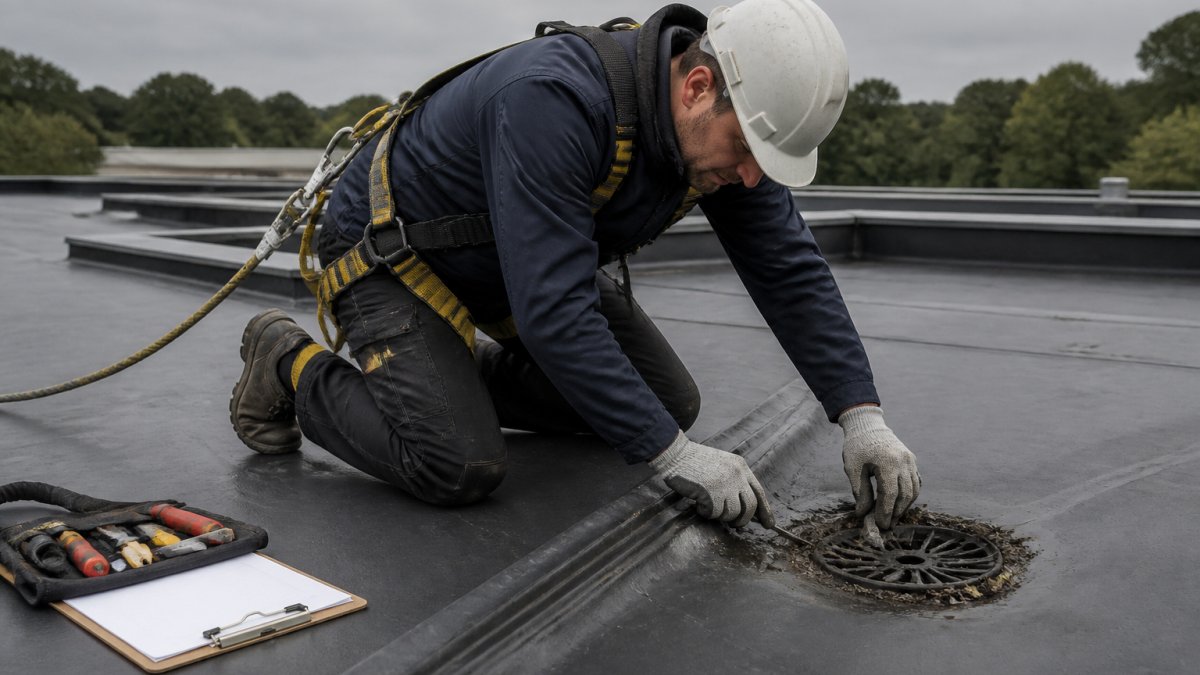
Here is what a professional visit should cover:
- Inspect the full membrane surface for splits, blisters, punctures and ponding
- Check every seam and lap for lifting or separation
- Examine upstands, flashings and the junctions where the roof meets walls
- Clear gutters, outlets and drainage channels of leaves and debris
- Check outlet flow with water where access allows
- Inspect skylights, vents and any penetrations for failed seals
- Photograph defects and note roof condition in a written report
- Advise on any repair needed, with the reason and the urgency
If a quote does not mention drainage, seams and upstands, it is not a maintenance visit. It is a look.
Flat Roof Repair or Replacement: Making the Cost-Effective Choice
Repair wins when the membrane is sound and the fault is local: a split, a failed seal, a blocked outlet causing water ingress. Replacement wins when the membrane has reached the end of its life, when leaks recur in different places, or when repairs start costing more than the roof is worth.
The decision usually comes down to three questions:
- Is the problem in one place or across the roof? Local faults are repairs.
- How old is the membrane and what condition is the rest of it in? A tired felt roof with one leak will produce another leak next winter.
- What have you already spent on call-outs? Repeated repairs on the same roof are a replacement cost spread over several years.
For a fuller breakdown of repair pricing, see our guide to flat roof repair costs. If you are weighing the two options directly, our repair versus replace decision guide walks through the same questions against your own roof.
Maintenance Costs by Flat Roof Material and System
Maintenance costs differ by material because each system ages and fails in its own way, and because the amount of seam, flashing and coating work a visit involves varies sharply between systems. Understanding these variables provides a clearer picture of how specific roofing needs fit into the broader spectrum of home maintenance costs.
| System | Typical annual maintenance cost | Recommended visits per year | What a visit focuses on |
|---|---|---|---|
| Reinforced bitumen felt (torch-on or pour-and-roll) | £150-£350 per year | 2 | Laps and seams, blistering, upstand flashings, outlet clearing |
| EPDM rubber (single-ply) | £120-£280 per year | 1-2 | Flashings, penetrations, outlet seals, ponding checks |
| GRP fibreglass | £140-£300 per year | 1-2 | Surface cracking, topcoat condition, edge trims, outlets |
| Liquid-applied systems | £160-£350 per year | 2 | Cracking, re-coating intervals, detail junctions, drainage |
| Single-ply PVC/TPO | £130-£300 per year | 1-2 | Seams, mechanical fixings, flashings, outlets |
Felt roofing has more laps and joints than any other common system, and those laps are where it typically needs attention first. A felt roof under trees may need its outlets cleared twice a year, and lap repairs every few years as the bitumen ages.
EPDM rubber is a single-ply membrane with few seams, so visits tend to focus on flashings, outlets and any penetrations rather than seam repair.
GRP fibreglass is rigid and seam-free, but its topcoat can chalk and crack with UV exposure. Maintenance visits check surface condition and edge trims.
Liquid-applied systems need checking for cracking and re-coating over time, and because they are often used on complex roofs with many details, visits take longer.
Single-ply PVC and TPO sit between EPDM and felt: fewer seams than felt, but mechanical fixings and heat-welded seams that need checking.
The practical point is this: a system with fewer joints gives a maintenance visit less to go wrong, which keeps both the visit and the repair bill smaller. Our flat roof lifespan by material guide shows how maintenance spend relates to how long each roof system lasts.
Preventive Maintenance vs Deferred Repair: The Real Cost Comparison
Deferred maintenance is not a saving. It is a bill moved to a later date with interest added, and the interest is usually paid in water ingress, damaged ceilings and insulation that has to be replaced along with the roof.
| Approach | Typical annual spend | What you pay for | What tends to happen to the roof |
|---|---|---|---|
| Planned maintenance (two visits) | £150-£350 per year | Inspection, drainage clearing, minor sealant, written report | Small faults caught early, drainage clear, membrane life protected |
| Deferred repair (no visits) | £0 until failure | Nothing until something fails | Ponding water and blocked outlets do damage long before it shows indoors |
| Reactive call-out after a leak | £250-£600 per incident, plus repair | Emergency labour, diagnosis, repair, possible internal making good | Water has often travelled; insulation and ceilings may need replacement |
| Full replacement after prolonged neglect | £1,800-£4,500+ depending on system and access | New membrane, labour, access, waste removal | The roof reaches end of life earlier than its material should allow |
The mechanism matters more than the numbers. A blocked outlet holds water on the membrane. Standing water finds the weakest seam or flashing, and once it is through the waterproof layer it travels laterally through insulation before it appears on a ceiling.
Roofs that receive planned maintenance generally reach the end of their service life closer to the material's expected lifespan, while neglected roofs can fail early.
A common mistake is treating maintenance as optional once a roof is out of warranty or has been "fine for years". Flat roofs fail quietly, and ponding water or a blocked outlet does its damage long before it shows up indoors.
Book Your Flat Roof Maintenance Visit with ARRC Ltd
A roof that is checked, cleared and recorded twice a year is a roof you stop worrying about. That is the whole argument for professional maintenance, and it is the service we have built around flat roofs across the region for over 30 years.
ARRC Ltd fits and maintains EPDM rubber flat roofs, backed by a 20-year guarantee on our flat rubber roofs. We also handle fascias, soffits and skylights, so you are not coordinating several trades.
If you are ready to book, our garage flat roof service page covers what we do and how to request a quote. For homeowners who want to check their own roof between visits, our flat roof maintenance checklist is a useful starting point.
Frequently Asked Questions
How much does professional flat roof maintenance cost?
The cost of professional flat roof maintenance depends on roof size, access, material and the scope of work. A routine inspection and minor upkeep typically costs less than a full repair visit. Because rates vary by contractor and property, ask for an itemised quote that separates inspection, cleaning and any minor repairs. For current prices or a quote, contact ARRC Ltd directly.
How often should a flat roof be professionally maintained?
Most flat roofs benefit from a professional inspection once a year, ideally before winter. Roofs with heavy foot traffic, mature trees nearby or existing drainage issues may need checks every six months. Regular maintenance catches small issues like blocked outlets or lifted seams before they become leaks. A planned schedule also helps you budget for flat roof maintenance costs instead of facing unexpected repair bills.
Is it cheaper to repair or replace a flat roof?
A targeted repair is usually cheaper in the short term, but repeated repairs on an ageing roof can cost more than a replacement over five to ten years. If the membrane is brittle, has multiple leaks or is past its service life, replacement often provides better value. A professional inspection will confirm whether a flat roof repair or replacement is the right call for your property.
What is included in a professional flat roof inspection?
A thorough inspection covers the membrane surface, seams, drainage outlets, flashings, upstands and roof access points. The roofer should clear debris, check for water ingress and provide a written report with photos. Ask whether minor repairs are included or quoted separately.
Flat roofs rarely fail without warning. They give notice through ponding, lifted seams and blocked outlets, and a maintenance plan is simply how you make sure someone is looking. Get started with ARRC Ltd and put your flat roof on a proper maintenance schedule, backed by three decades of experience and a 20-year guarantee on our rubber roofs.