 how-to
Are There Signs of Asbestos in Your Old Soffits?
Last Updated: October 26, 2026
Quick Summary
Signs of asbestos soffits include flat, dull, chalky cement boards in white, grey or pale cream, with shallow back-face dimples, brittle chipped edges and hairline cracks around fixings. Homes built or refurbished before 2000 carry the highest risk, especially pre-1980s properties. Appearance alone never confirms asbestos, so keep suspect boards undisturbed and arrange laboratory testing.
- Asbestos cement was used because it was cheap, fire-resistant and did not rot.
- Check suspect boards from the ground with binoculars and never poke, scrape or drill them.
- Asbestos cement boards feel heavy and rigid, while modern uPVC panels usually flex.
- A laboratory sample is analysed by polarised light microscopy to identify fibres.
- Intact boards can often be left in place and checked each year.
Table of Contents
- Where Asbestos Hides in Old Soffits and Roofline Materials
- What Do Asbestos Soffits Look Like? Visual Clues to Check
- Asbestos Cement vs Other Asbestos Materials in the Roofline
- Why Appearance Alone Cannot Confirm Asbestos
- Asbestos Soffit Testing: What a Sample and Survey Involve
- What to Do If Soffits Contain Asbestos: A Safe Decision Path
- Asbestos Soffit Removal, Repair or Replacement: Which Is Right?
- Book a Soffit Inspection Before Your Next Roofing Job
- Frequently Asked Questions
Where Asbestos Hides in Old Soffits and Roofline Materials
Asbestos in old soffits is most often found in cement-based boards fixed under the eaves, and those boards can be hard to tell apart from modern alternatives.
Soffits are the panels that close the gap between the wall and the roof edge.
Older properties often used asbestos cement for these panels. It was cheap, it lasted, and it did not rot.
Why Soffits Were Built With Asbestos Cement
Builders reached for asbestos cement because it was tough, fire-resistant and shrugged off wet weather better than timber.
The material was mixed with cement, so the fibres were tightly bound. A board in good condition holds those fibres in; a cracked or broken board does not.
How Building Age Changes the Risk
The chance of finding asbestos rises sharply with the age of the property. Homes built or refurbished before the year 2000 are the ones to watch (The duty to manage asbestos in buildings).
- Pre-1980s: highest risk, when asbestos use was at its peak
- 1980s to 1999: still possible, especially in soffits and garage roofs
- 2000 onwards: very unlikely, as the material was banned
If you do not know when your roofline was last touched, assume nothing. A visual check is a start, not a verdict.
What Do Asbestos Soffits Look Like? Visual Clues to Check
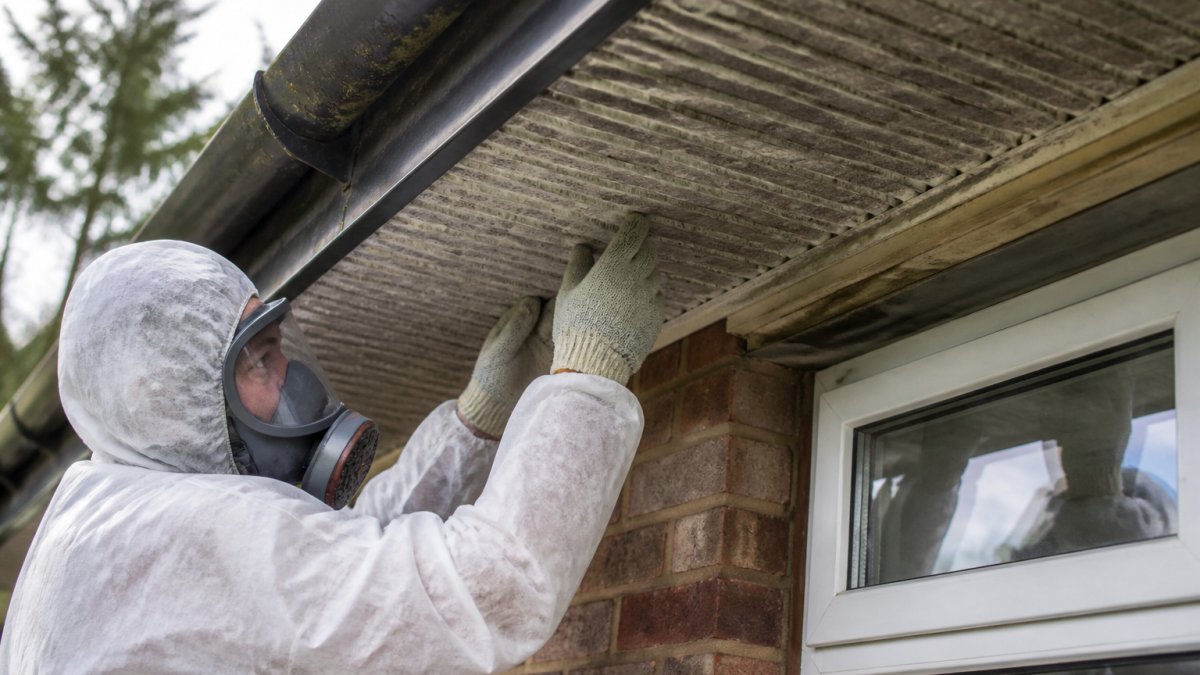
Asbestos soffits usually look like flat or slightly textured cement boards, often white, grey or pale cream, with a dull, chalky finish.
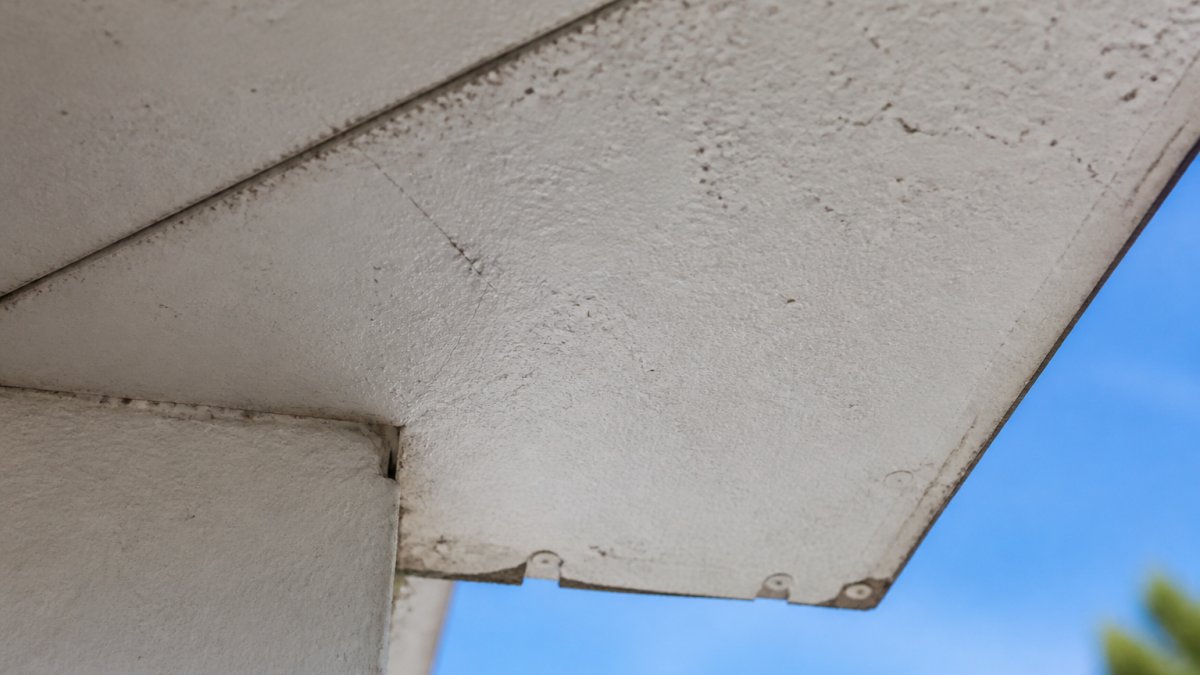
- Surface texture: hard, cement-like and dense; not soft, springy or wood-grained.
- Back-face dimples: shallow circular dimples or press marks from manufacture, typically 5-10 mm across.
How to Tell Asbestos Cement from Modern Alternatives
A practical comparison by age, surface, edges, installation and material type can narrow the possibilities, but it cannot replace testing.
| Feature | Asbestos cement soffit | Modern uPVC soffit | Timber soffit |
|---|---|---|---|
| Typical age | Pre-2000, most common pre-1980s | 1990s onwards | Any age; often replaced |
| Surface | Dull, chalky, cement-like; often painted | Smooth, glossy or woodgrain-effect | Grained, painted or stained |
| Edges | Sharp, brittle, chip easily | Hollow channel, flexible, snap-fit | Straight, may splinter |
| Weight and rigidity | Heavy and rigid | Light and flexible | Moderate; can warp |
| Fixings | Nails or screws through face | Concealed fixings or clips | Nails or screws |
| Sound when tapped (from safe distance) | Dull, hard tone | Hollow, plastic tone | Hollow, wood tone |
| Back face | Dimpled or smooth cement | Hollow with support ribs | Rough sawn or planed |
The clearest single clue is rigidity: asbestos cement boards do not flex, while modern uPVC panels usually do. That said, some post-ban fibre-cement alternatives look almost identical, so age and installation details matter as much as appearance.
Cracking, Weathering and Deterioration
Look for cracking, damage and weathering along the edges and around fixings.
Hairline cracks and debris in the joints are common. Any board that is crumbling, flaking or losing its shape deserves a professional look, not you on a ladder.
Photograph any suspect board from ground level. That record helps a surveyor plan safe sampling and gives you a baseline for annual checks.
Asbestos Cement vs Other Asbestos Materials in the Roofline
Not all asbestos in a roofline is the same.
| Material | Where It Appears | How Friable | Handling |
|---|---|---|---|
| Asbestos cement sheet | Soffits, fascia backing, garage roofs | Tightly bound, low risk if intact | Careful removal by a trained fitter |
| Asbestos insulation board (AIB) | Linings, infill panels | Soft, easily crumbled | Specialist licensed removal |
| Textured coatings | Painted soffit faces | Low risk unless sanded | Do not sand or scrape |
The key point: white asbestos and brown asbestos can both turn up in cement, but the cement matrix keeps fibres locked in while the board stays whole. AIB has no such protection.
If you are weighing up replacement materials, our guide on how to choose fascia and soffit materials walks through the modern options.
Why Appearance Alone Cannot Confirm Asbestos
Appearance alone cannot confirm asbestos because several modern materials mimic old cement board.
This is where most homeowners go wrong: they see a grey board and either pull it down or cut into it. Both are risky.
A building material can look identical to asbestos cement and contain none, and a harmless-looking board can test positive. You cannot see fibres with the naked eye.
Asbestos Soffit Testing: What a Sample and Survey Involve
Here is what a proper process looks like:
- A professional survey of the soffits and surrounding roofline
- A small sample taken safely, with the area wetted to limit dust
- The sample sealed and sent for laboratory testing
For official guidance on identifying and managing asbestos, see the Health and Safety Executive guidance on asbestos. It sets out where the material is found and who can work on it.
What Laboratory Analysis Actually Involves
A sample of suspect soffit material is analysed at an accredited laboratory, typically using polarised light microscopy (PLM) to identify asbestos fibres by their optical properties. The analyst examines a sub-sample, often after crushing or mounting it on a slide, and records the type and approximate proportion of any asbestos present.
Key points about the analysis:
- Accreditation matters. In the UK, laboratories carrying out asbestos identification should be accredited to ISO/IEC 17025 for the specific test. Ask for the accreditation number and the scope of the test.
- The sample is small. A result reflects the material submitted, not necessarily every board on the roofline. If boards differ in age or appearance, more than one sample may be needed.
- Turnaround is usually a few working days. Some laboratories offer faster turnaround at higher cost; agree this before sampling if the result is urgent.
How to Interpret Positive, Negative and Inconclusive Results
- Positive result: asbestos is present. The report should identify the type and proportion. Do not disturb the material; follow the surveyor's advice on management, repair or licensed removal.
- Negative result: no asbestos was detected in the sample submitted. This is reassuring but not absolute, it applies to the sampled material only. If other boards look different or were installed at a different time, consider further sampling.
- Inconclusive or 'trace' result: the laboratory may report fibres below a reporting threshold or note that the sample was unsuitable. Treat this as unresolved and seek advice on re-sampling or a fuller survey.
A common pattern is for homeowners to rely on a single negative result for a whole roofline. Most practitioners advise matching the number of samples to the number of visually distinct board types and installation phases.
Sample Limitations and What a Survey Adds
A laboratory result is only as good as the sample. A surveyor adds context: the extent and condition of suspect material, access arrangements, and whether removal needs a licensed contractor. For soffits, the survey should also note fascias, guttering and supporting timber, since these affect the repair plan.
If the material is confirmed as asbestos cement in good condition, the usual advice is to manage it in place and monitor annually.
What to Do If Soffits Contain Asbestos: A Safe Decision Path
If your soffits contain asbestos, the right move depends on condition. Intact boards can often be left alone and monitored; damaged boards need professional attention.
Use this simple decision path:
- Board intact, no damage? Leave it, note its location, and check it each year.
- Minor damage, low-level material? A trained contractor can repair or seal it.
- Crumbling, broken or friable material? Stop. Keep people away and call a specialist.
- Planning a roofing job? Have the soffits assessed before work starts.
Never jet-wash, sand or scrape a suspected board, that is the fastest way to release asbestos fibres into the air.
If you are unsure, treat it as asbestos until a test says otherwise. That is the safe default.
Asbestos Soffit Removal, Repair or Replacement: Which Is Right?
Asbestos soffit removal is not always the answer.
- Repair: best for intact or lightly damaged cement board that can be sealed
- Replacement: sensible when boards are failing, timber is rotting, or you want a modern finish
- Removal: needed when the material is friable or the roofline is being rebuilt
Replacing soffits is often the moment to do the fascias too, since the two sit together. Our guide on replacing fascias and soffits together explains how to plan both jobs in one go.
If cost is on your mind, the fascia and soffit replacement cost guide sets out what affects the price.
Book a Soffit Inspection Before Your Next Roofing Job
Book a soffit inspection before any roofing work begins, disturbing an untested board is the biggest avoidable risk on an older roofline.
Our team brings over 30 years of experience and a 20-year guarantee on our flat rubber roofs.
If you want to understand what a proper installation involves first, read our professional fascia and soffit installation guide.
Frequently Asked Questions
Can you identify asbestos in soffits by sight alone?
No. Asbestos cement soffit boards look almost identical to modern fibre cement and other non-asbestos alternatives, so a visual check can only flag suspicion, not confirm it.
What does asbestos soffit testing involve and how long does it take?
Asbestos soffit testing usually means a surveyor takes a small sample from an inconspicuous area, seals it and sends it to an accredited laboratory for analysis. Results often come back within a few working days. A full asbestos survey also records the condition of the boards, whether fibres could be released and what action is needed. Ask for the test result in writing and keep it with your property documents for future buyers and contractors.
Can damaged asbestos soffits release fibres?
Asbestos cement is a tightly bound material, so intact boards pose a low risk. Once boards are cracked, chipped or weathered, fibres can be released as dust, especially during disturbance such as cleaning, drilling or removal. Keep people away from crumbling edges, avoid sweeping up debris with a dry brush and do not attempt DIY removal. A professional can assess the condition and advise whether repair, encapsulation or removal is appropriate.
Is it safe to replace soffits that may contain asbestos?
Replacement is possible, but asbestos soffit removal should be handled by trained contractors following the correct safe handling and disposal rules, and any waste must go to a licensed site. Never break boards up to fit a skip. If the boards are sound and undamaged, some properties can simply have new soffits fitted over them. A surveyor or experienced roofing team can confirm which route suits your property before work starts.
An old roofline should not keep you guessing. Get a clear answer on your soffits before the next storm or roofing job forces the issue. Get started with ARRC Ltd and book a soffit inspection with a team that has spent three decades getting rooflines right. Get in touch with ARRC Ltd Roofing for a free quote.