 blog
Best Tools for Cutting Fascia Boards: 2026 Guide
Table of Contents
- Best Tools for Cutting Fascia Boards: A Material-by-Material Comparison
- How to Cut Fascia Boards: Measuring, Marking and Making the Cut
- The Best Saw for Cutting uPVC Fascia Boards
- How to Cut Fascia Board Angles at Roof Peaks and Corners
- The Best Blade for Cutting Composite Fascia Boards
- Safety, Dust Control and On-Site Troubleshooting
- What to Budget For: Tool Costs and Trade-OFFS
- Frequently Asked Questions
Last Updated: October 20, 2026
Best Tools for Cutting Fascia Boards: A Material-by-Material Comparison
The right tool for cutting fascia boards depends entirely on what the board is made of. A blade that slices through timber will burn its way across uPVC, and a toothed saw that handles composite cleanly will chip fibre cement.
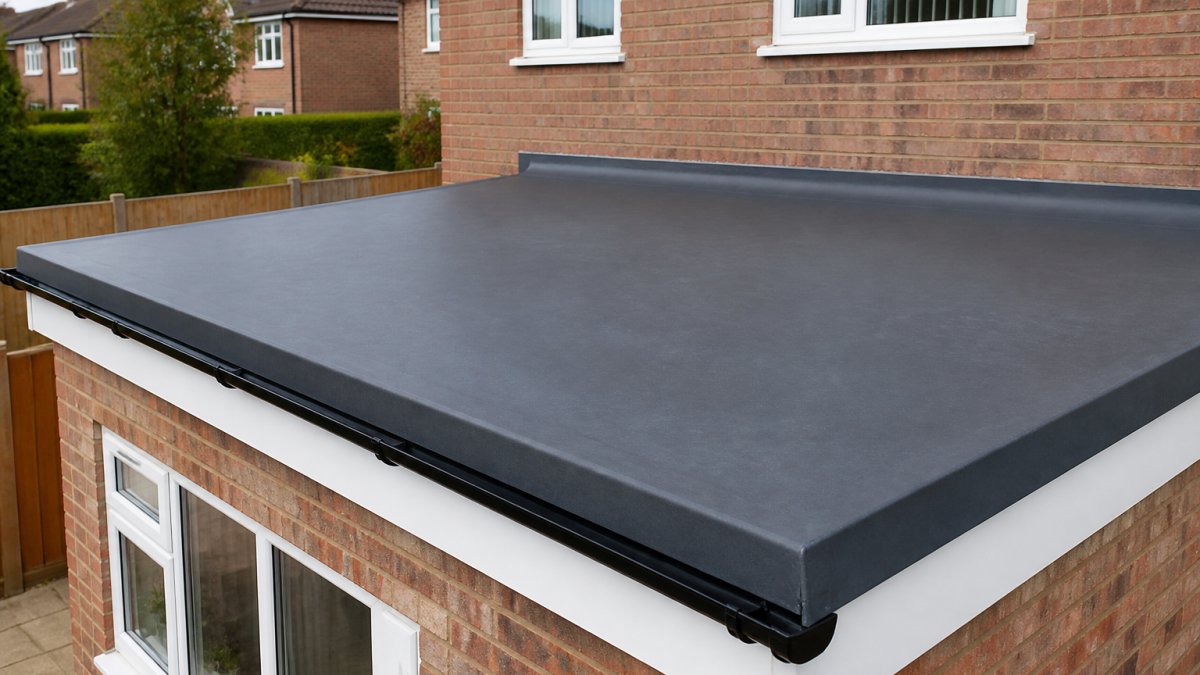
Fascia board is the horizontal band fixed to the rafter feet along the bottom edge of a roof, carrying the guttering and closing off the roof structure. Cutting fascia boards well means matching three things: the saw, the blade, and the material in front of you. Get that match right and the cut is square, clean and quick.
Below, we break down which tool suits which board, how to mark and cut accurately, and where the money goes. The comparison table first, because that is the question most people are actually asking.
Quick Comparison: Tool vs Material vs Cut Quality
| Material | Best Tool | Blade Type | Cut Quality | Notes |
|---|---|---|---|---|
| Softwood timber | Circular saw | Carbide-tipped 24-40T | Clean, fast | Support the offcut or it splinters |
| uPVC | Jigsaw or handsaw | Fine-tooth, no heat build-up | Clean with slow feed | Fast blades melt and burr the edge |
| Composite | Circular saw or mitre saw | Carbide-tipped, high tooth count | Very clean | Score the face first to stop chipping |
| Fibre cement | Circular saw with dust extraction | Diamond or fibre-cement blade | Clean, dusty | Respiratory protection is essential |
| Capped board | Jigsaw | Fine-tooth metal or plastic blade | Clean on the cap | Cut from the back where possible |
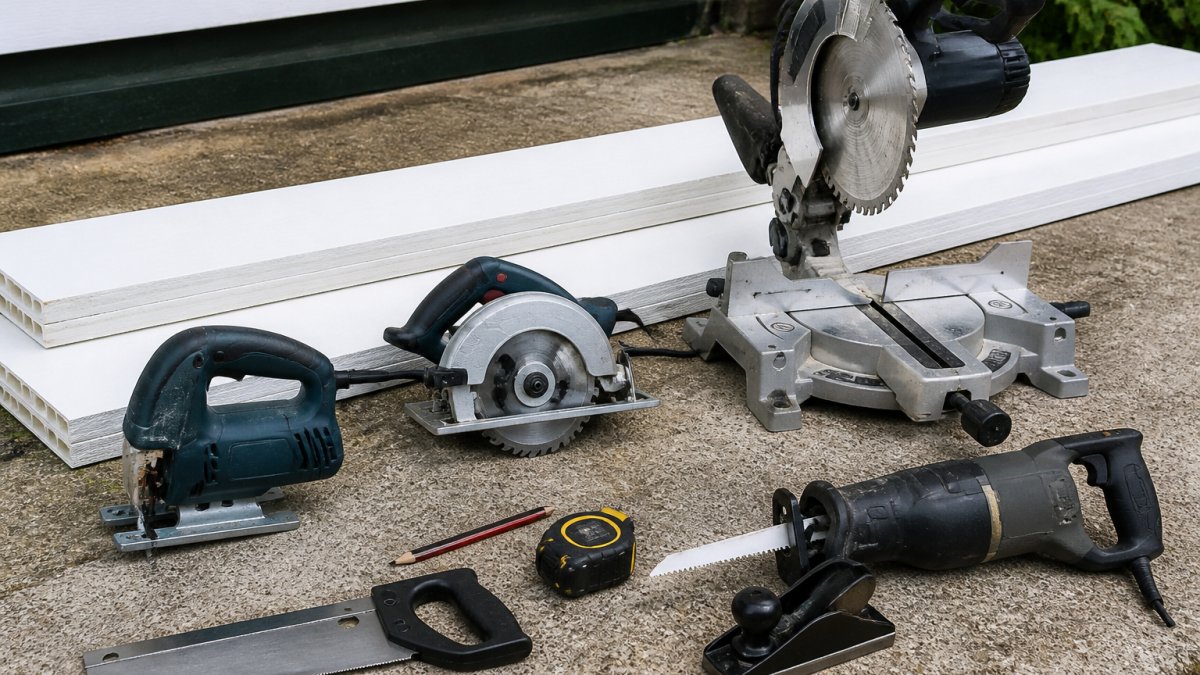
The pattern is simple: timber and composite reward a carbide-tipped circular saw, plastics reward a fine-tooth jigsaw, and fibre cement needs a diamond blade and serious dust control. Everything else in this guide builds on that table.
How to Cut Fascia Boards: Measuring, Marking and Making the Cut
Good cuts start before the saw is switched on. Measure twice against the actual rafter run, not the old board, because old fascias sag and twist and will give you a false length. Mark the cut line with a pencil and check it against a speed square before you commit.
Work through it in this order:
- Set the board on two sawhorses so both sides of the cut are supported.
- Measure the run and transfer the measurement with a tape, then square the line across the face with a speed square or framing square.
- Mark the waste side clearly so you do not cut the wrong side of the line.
- Score the face with a sharp knife on composite and capped boards to prevent chipping.
- Cut just outside the line and finish with a light pass, or sand the edge square.
- Dry-fit the board before fixing. On-site adjustment is normal, so leave yourself a millimetre or two.
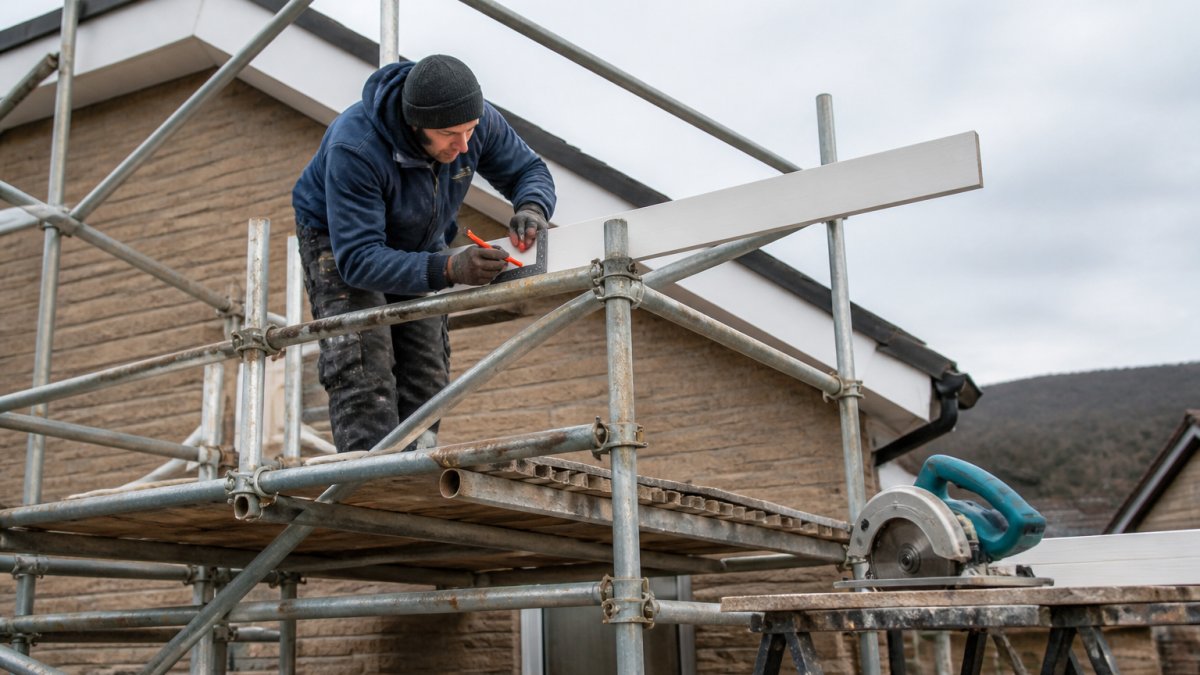
A common mistake is cutting to the exact measurement with no allowance for the angle of the roofline or the thickness of the gutter bracket. That is how boards end up short and gaps appear at the corners.
The Best Saw for Cutting uPVC Fascia Boards
The best saw for cutting uPVC fascia boards is a jigsaw fitted with a fine-tooth blade, run at a slow speed. uPVC is a plastic, and plastic reacts to heat. A fast-turning circular saw or an aggressive blade will melt the edge, leave a burr, and produce a cut that never sits flush.
Where a jigsaw is not to hand, a fine-tooth handsaw works well and gives you more control on short cuts. An oscillating multi-tool is useful for notching around rafter feet and for trimming a board already fixed in place, where a full saw will not fit.
A few practical points we would pass on:
- Let the blade do the work. Pushing hard generates heat and heat ruins the edge.
- Cut from the back face where the profile allows, so any minor chipping is hidden.
- Deburr the cut edge with a fine file or sandpaper before fitting.
- Never cut uPVC in freezing conditions if you can avoid it; cold plastic is brittle and cracks.
Get the blade and speed right and a uPVC fascia cuts like butter. Get them wrong and you will be buying a replacement board.
How to Cut Fascia Board Angles at Roof Peaks and Corners
Cutting fascia board angles comes down to transferring the roof pitch onto the board. At a roof peak, the two fascia runs meet at the apex, and each board needs an angle cut that matches the pitch so the joint closes tight. At corners, the boards meet at 90 degrees and need a simple square cut or a mitre.
Here is how we would approach it on site:
- At the peak: measure the pitch angle, set your mitre saw or circular saw to half that angle on each board, and dry-fit both before fixing. The two cuts should meet on the centre line of the apex.
- At external corners: a 45-degree mitre on each board gives a clean corner joint. Mark both boards from the same corner reference so they line up.
- At internal corners: a square cut on each board butted into a corner trim is faster and more forgiving than a mitre.
- On unequal pitches: treat each side separately and cut to its own angle. Do not assume symmetry.
Use a speed square to transfer the angle from the rafter to the board face. If the roofline is out of square, which older properties often are, cut to the actual building angle rather than the theoretical one. A cutting jig set to the pitch makes repeat cuts consistent.
The Best Blade for Cutting Composite Fascia Boards
The best blade for cutting composite fascia boards is a carbide-tipped blade with a high tooth count, used on a circular saw or mitre saw. Composite boards are dense and abrasive, and a low-tooth ripping blade will chip the face and leave a ragged edge that shows once the board is up.
Blade selection by material is where most of the cut quality is won or lost:
- Composite: carbide-tipped, 60 teeth or more, fine cut. Score the decorative face first.
- Timber: carbide-tipped, 24 to 40 teeth. Fewer teeth cut faster, more teeth cut cleaner.
- uPVC: fine-tooth jigsaw blade or a plastic-specific blade. No heat build-up.
- Fibre cement: a diamond blade or a blade rated for fibre cement, with dust extraction attached.
A mitre saw gives the most consistent results on composite because the board is supported and the angle is set once. For long runs, a circular saw with a clamped straight edge works nearly as well. Either way, cut slowly and let the blade finish the cut rather than forcing it.
Safety, Dust Control and On-Site Troubleshooting
Safety and dust control separate a professional job from a messy one. Fibre cement and composite boards produce fine dust that is harmful to breathe, so fit a dust extraction unit or use a saw with an integrated extraction port, and wear a suitable respirator. Eye protection and hearing protection are non-negotiable with any powered saw.
On the dust and safety front:
- Cut fibre cement outdoors or in a well-ventilated area, never in an enclosed space.
- Use dust extraction or a water-assisted cutter where the manufacturer specifies it.
- Wear gloves when handling cut edges; fibre cement and composite edges are sharp.
- Keep cables clear of the cut line and use an RCD-protected supply.
Troubleshooting the common problems:
- Chipped face on composite: blunt blade or cutting from the wrong side. Score first, cut from the back.
- Melted edge on uPVC: blade too fast or too coarse. Slow down and switch to a fine-tooth blade.
- Splintered timber: no support under the offcut. Support both sides.
- Wandering cut line: freehand cutting. Clamp a straight edge as a guide.
- Blade binding mid-cut: board pinching as it closes. Support the board and check your sawhorses are level.
For anyone working at height on fascia and soffit, the HSE guidance on working at height is worth reading before you set up a tower or ladder. Getting the access right is as important as getting the cut right.
What to Budget For: Tool Costs and Trade-OFFS
Budget depends on whether you are buying for one job or for a trade. For a single fascia replacement, hiring or borrowing the right saw beats buying one you will never use again.
The trade-offs are straightforward:
- Circular saw: the most versatile single purchase. Handles timber, composite and, with the right blade, fibre cement. Buy a good one and a selection of blades.
- Jigsaw: essential for uPVC and for cuts in place. Cheaper than a circular saw and more controllable on plastics.
- Mitre saw: the best choice for repeat angle cuts at peaks and corners, but bulky and not much use for long straight runs.
- Oscillating multi-tool: a finishing tool, not a primary cutter. Invaluable for trimming and notching.
- Blades: budget for the right blade per material. A cheap saw with the correct blade beats a premium saw with the wrong one.
We would not put a figure on tool prices here because they move with brand and spec, and we would rather you check current prices than work from a stale number.
For material and installation standards, the LABC guidance on fascia and soffit installation is a useful reference on what a compliant job looks like.
Fitting fascias and soffits at height, around roof peaks and awkward corners, is where a good cut turns into a good job, and where a poor one turns into leaks and callbacks.
Frequently Asked Questions
Can you cut fascia boards with a circular saw?
Yes. A circular saw with a fine-tooth carbide-tipped blade handles most timber and composite fascia boards cleanly, and it is the fastest option for long straight cuts along a board. Set the blade depth so it clears the board by about 5mm to reduce splintering, and score the cut line first on uPVC to stop chipping. For mitres and short trims a mitre saw gives a squarer finish, so many installers keep both on site. Support the board on a sawhorse so the offcut does not tear away as the blade exits.
What is the easiest tool to cut aluminium soffit or fascia?
For aluminium soffit and fascia, a fine-tooth blade in a circular saw or a jigsaw with a metal-cutting blade gives the cleanest edge, and aviation snips work well for short trims and notches. Clamp or tape the panel firmly and cut slowly, because thin aluminium vibrates and snags. Wear eye protection and gloves, as the cut edge is sharp. For long runs, a nibbler or powered shear leaves a flatter edge with less distortion than a saw, which matters when the panel is visible from below.
How do you cut fascia board angles accurately?
Set out the angle from the actual roof, not from a drawing. Hold a framing square or speed square against the rafter end, mark the plumb line, then transfer that angle to the fascia board and cut just outside the pencil line before trimming to fit. Test-fit the board dry before fixing. For corner mitres, cut both boards slightly long and adjust. A mitre saw with a locking table makes repeat angles easier, but a circular saw guided by a speed square works for awkward on-site angles.
Should fascia boards be cut with a mitre saw or a circular saw?
Use a mitre saw for accurate angles, short lengths and repeat cuts such as corner returns, and a circular saw for long straight runs where the board is too unwieldy to lift onto a bench. In practice most fascia work uses both: the circular saw breaks down the length, and the mitre saw finishes the angle. Whichever you use, a sharp, fine-tooth blade matters more than the machine, and a speed square keeps your cut line true when working at height.