 ultimate-guide
What Is EPDM Roofing Made Of? Materials Explained
Table of Contents
- The Raw Materials Behind EPDM Roofing
- How EPDM Roofing Is Manufactured
- EPDM Roofing Thickness: What the Numbers Mean
- How Long Does EPDM Roofing Last?
- EPDM Roofing Pros and Cons
- EPDM Roof Maintenance Tips for Long-Term Performance
- Frequently Asked Questions
Last Updated: September 25, 2026
The Raw Materials Behind EPDM Roofing
EPDM roofing is made from a synthetic rubber membrane whose name comes directly from its three building blocks: ethylene, propylene, and diene monomer. Those three ingredients are combined with fillers, oils, and a vulcanising agent, then cured into a flexible sheet roughly 1.1 mm to 1.5 mm thick for domestic flat roofs. In short, what is EPDM roofing made of is a simple chemical recipe: two gases from the petroleum industry, one diene, and a curing system.
That recipe matters because it explains nearly every performance claim you'll read about EPDM. This guide from ARRC Ltd breaks down each raw material, how the membrane is manufactured, what the thickness numbers actually mean, and where EPDM wins and loses against other flat roofing options.
Ethylene Propylene Diene Monomer is the full chemical name behind the abbreviation. It is a synthetic rubber membrane manufactured from petroleum by-products, and its molecular structure is what gives it elasticity, weather resistance, and a service life measured in decades rather than years.
Ethylene, Propylene, and Diene: The Three Monomers
Each monomer does a distinct job, and the balance between them decides how the finished sheet behaves.
- Ethylene forms the backbone of the polymer chain. A higher ethylene content makes the membrane stiffer and stronger, which helps with tensile strength.
- Propylene introduces irregularity into the chain, keeping the material flexible at low temperatures. This is why EPDM stays pliable in a hard frost instead of cracking.
- Diene provides the double bonds that allow vulcanisation. Without it, the rubber could not be cross-linked into a durable, heat-stable sheet.
The ratio of these three is adjusted by the manufacturer to hit a target balance of flexibility, strength, and thermal stability. It is an elastomeric material, meaning it stretches and returns to shape rather than deforming permanently. The saturated backbone of the ethylene-propylene chain is the reason EPDM resists attack from oxygen and ozone so effectively, there are no reactive double bonds left in the main chain for those molecules to break, which is why the material does not perish the way natural rubber does.
Why Petroleum By-Products Matter
Ethylene and propylene are produced during the cracking of natural gas and crude oil fractions. EPDM therefore sits at the end of a hydrocarbon supply chain, and the purity of those feedstocks has a direct effect on membrane quality.
What most guides miss is that feedstock purity affects how consistently the finished membrane cures. Impurities can leave weak points that only show up after years of thermal expansion and contraction. This is one reason two visually identical sheets can perform very differently.
The Chemical Resistance Profile
Because the polymer backbone is saturated, EPDM shrugs off a wide range of substances that would degrade other flat roofing materials. Most practitioners find it handles the following well:
- Ozone and UV radiation, the primary weathering agents on any flat roof
- Water and steam, including the standing water that collects in low spots
- Alkalis and many acids, relevant where roof run-off meets mortar or concrete
- Alcohols and ketones, common in cleaning products and industrial atmospheres
- Phosphate esters and glycol-based fluids, found in some heating and cooling systems
What EPDM does not tolerate well is prolonged contact with petroleum-based oils, greases, and solvents. These swell the rubber and break down the cross-linked network over time. On a domestic flat roof this rarely matters, but it is worth knowing if the roof sits above a garage, plant room, or anywhere oil mist or fuel vapour might settle.
Fillers, Oils, and Curatives
The three monomers are only part of the recipe. The compounded rubber also contains:
- Carbon black, the primary reinforcing filler, which gives the sheet its characteristic black colour and adds UV stability and tensile strength
- Process oils, paraffinic or naphthenic oils that soften the compound for forming and keep it flexible in service
- Curatives, sulphur or peroxide systems that drive the vulcanisation reaction
- Accelerators and activators, small additions that control how quickly and evenly the cure proceeds
- Antioxidants and antiozonants, sacrificial additives that protect the polymer from long-term atmospheric attack
How EPDM Roofing Is Manufactured
Manufacturing starts with polymerisation, where ethylene, propylene, and diene are reacted under controlled heat and pressure to form long polymer chains. The resulting rubber is then compounded with carbon black, process oils, and curatives before being formed into a continuous sheet.
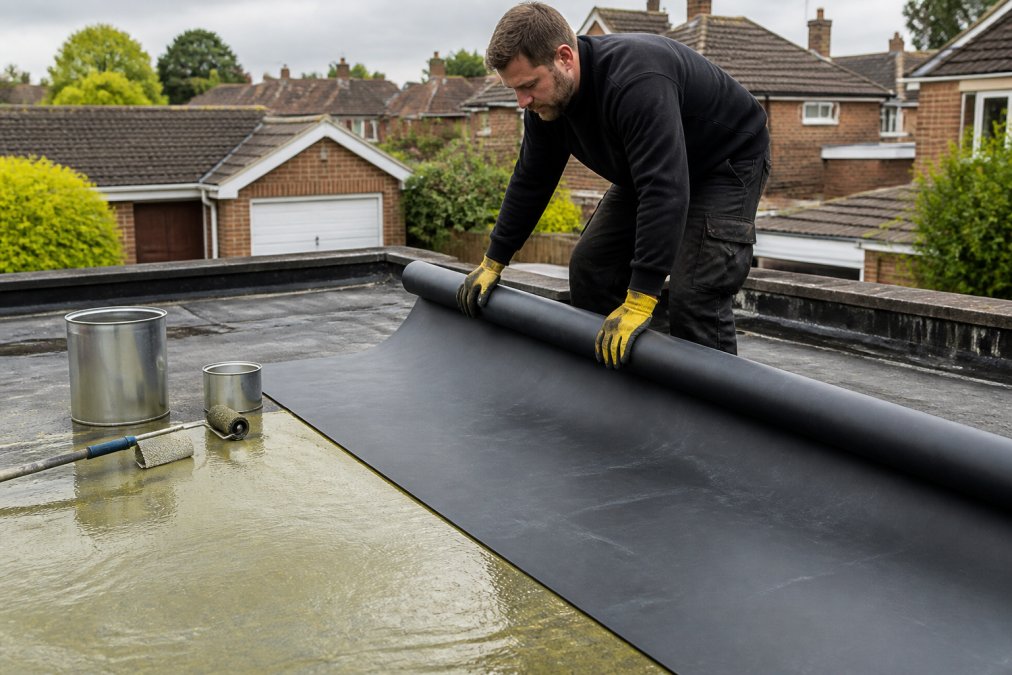
Polymerisation and Vulcanisation Explained
Polymerisation builds the long-chain polymer. Vulcanisation then locks those chains together into a three-dimensional network using sulphur or a peroxide curing system.
EPDM Roofing Thickness: What the Numbers Mean
Membrane thickness is quoted in mils, where one mil is one thousandth of an inch. Domestic EPDM flat roofing typically runs from about 45 mil (roughly 1.1 mm) up to 60 mil (roughly 1.5 mm), with heavier gauges available for commercial work.
| Thickness | Approx. Metric | Typical Use | Notes |
|---|---|---|---|
| 45 mil | 1.1 mm | Garages, sheds | Lightest common domestic gauge |
| 60 mil | 1.5 mm | House extensions, bay windows | Most popular for homes |
| 75 mil+ | 1.9 mm+ | Commercial units, warehouses | Heavier wear and foot traffic |
How Long Does EPDM Roofing Last?
A properly installed EPDM roof commonly lasts 25 to 30 years, and many domestic installations comfortably exceed that. The material itself is often rated for longer, which tells you the limiting factor is rarely the rubber.
- Installation quality, particularly at seams and terminations
- Roof drainage, because standing water stresses the sheet and its joints
- Substrate condition, since a failing deck will move and pull the membrane with it
EPDM Roofing Pros and Cons
EPDM's strengths come straight from its chemistry, and so do its limitations. Here is the honest picture, including the end-of-life and thickness angles most guides skip.
Pros:
- Excellent UV resistance and ozone resistance for a long, stable service life
- Stays flexible in cold weather, so it copes well with thermal expansion
- Single-ply installation means fewer seams than many alternatives
- Low maintenance once correctly fitted
- Good chemical resistance against the usual atmospheric pollutants
- Available in a range of thicknesses, so the specification can be matched to the actual wear the roof will see
Cons:
- It is a hydrocarbon-based product, so its environmental profile depends on recycling at end of life
- Dark membranes absorb heat, which can affect a building's thermal performance
- Poor installation is the single biggest cause of premature failure
- It is not suitable for every roof shape, particularly where complex detailing is needed
- It is not resistant to petroleum-based oils and solvents, which limits use in some industrial settings
Thickness Is Not the Same as Durability
A common assumption is that a thicker membrane is automatically a longer-lasting one. That is only partly true. Thickness buys puncture resistance and tolerance of foot traffic, not immunity from failure. A 45 mil sheet on a garage that nobody walks on performs perfectly well, while a 60 mil membrane makes more sense on a balcony or a roof that sees regular maintenance access.
Environmental Impact and End-of-Life
This is the area most EPDM guides avoid, and it is becoming harder to ignore as sustainable construction requirements tighten.
- Reclaim and reprocessing, the membrane is ground down and the rubber crumb is reused in playground surfaces, sports tracks, and similar products. This is the preferred route but depends on a local processor being available.
- Energy recovery, the material is used as a fuel source in controlled waste-to-energy facilities, recovering some of its embedded energy.
- Landfill, still the fate of a significant proportion of stripped membrane, and the least desirable outcome.
EPDM Roof Maintenance Tips for Long-Term Performance
Maintenance is straightforward, and small habits are what stretch a 25-year roof towards 30.
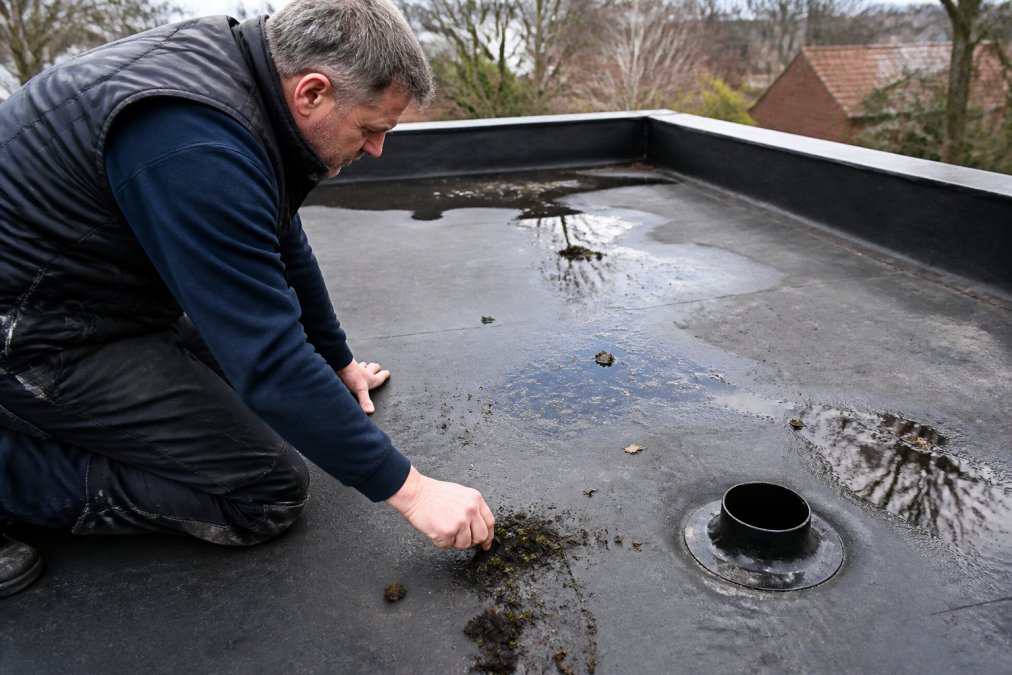
- Clear leaves and debris from outlets and gutters twice a year, and after autumn leaf fall
- Check for standing water after heavy rain and investigate any area that stays wet
- Inspect seams and edge trims annually for lifting or separation
- Keep sharp tools, ladders, and foot traffic off the membrane where possible
- Trim overhanging branches that drop debris or scrape the surface
Frequently Asked Questions
What are the downsides of EPDM roofing?
EPDM roofing has a few drawbacks worth knowing. It can be punctured by sharp objects or foot traffic during maintenance, and some adhesives used for seams can fail if not applied correctly. It also comes in a limited colour range, typically black or grey. However, when installed properly by an experienced contractor, these issues are rare and the membrane's durability outweighs them.
Can water sit on an EPDM roof without causing damage?
Yes, EPDM roofing handles standing water well because the synthetic rubber membrane is naturally waterproof and resistant to degradation from moisture. Unlike felt roofing, which can absorb water and deteriorate, EPDM remains stable. That said, persistent pooling can indicate a drainage problem, so it is worth checking that outlets and falls are working correctly. Addressing drainage early prevents long-term issues.
Is EPDM roofing environmentally friendly?
EPDM roofing has a mixed environmental profile. The membrane is made from petroleum by-products, which are non-renewable. However, EPDM is extremely long-lasting, often exceeding 40 years, which reduces the frequency of replacement and the waste that comes with it. Some EPDM products can also be recycled into other rubber goods, though recycling infrastructure for roofing membranes is still developing. Its longevity is its strongest sustainability argument.
How does EPDM compare to traditional felt roofing?
EPDM roofing outperforms traditional felt in several key areas. Felt roofing typically lasts 10 to 15 years, while EPDM can last 40 or more. EPDM is more flexible, so it handles thermal expansion and contraction without cracking. It also resists UV and ozone damage far better than felt. The main trade-off is upfront cost, which is higher for EPDM, but the lifespan difference makes it better value over time.