 ultimate-guide
Roofing Certification Requirements UK 2026
Table of Contents
- Why Roofing Certification Requirements Matter in 2026
- Building Regulations and Roofing Work: What Approval Covers
- Competent Person Scheme Roofing: How Self-Certification Works
- NVQ Levels, CSCS Cards and Trade-Specific Roofing Certification
- The Building Safety Act and Its Impact on Residential Roofing
- How to Verify Roofer Qualifications Before You Hire
- Waste Management and Environmental Obligations for Roofers
- Conclusion
Last Updated: August 18, 2026
Why Roofing Certification Requirements Matter in 2026
Roofing certification requirements in the UK have never carried more weight than they do right now. The convergence of the Building Safety Act, updated Part L energy efficiency standards, and tightening competent person scheme audits means that the gap between a certified roofer and an uncertified one is wider in 2026 than at any point in the last decade. A roof installed without proper certification can invalidate your home insurance, trigger enforcement action from your local building control authority, and leave you personally liable for remediation costs.
This guide cuts through the regulatory complexity and gives you a practical account of what roofing certification requirements actually mean in 2026: which approvals trigger a formal application, how self-certification schemes work, what qualifications to ask for before anyone sets foot on your roof, and what the Building Safety Act changes for residential properties. We also cover digital compliance tracking and the insurance consequences of hiring an uncertified contractor, two areas most guides overlook entirely.
Building Regulations and Roofing Work: What Approval Covers
Building Regulations compliance is the legal foundation for almost all significant roofing work. The regulations, administered under the Building Act 1984 and the Building Regulations 2010, set minimum standards for structural integrity, fire safety, energy performance, and drainage.
When Roofing Work Triggers a Full Building Regulations Application
Roofing work triggers a full Building Regulations application when it involves a structural change, a material alteration to the building envelope, or when the roof area being replaced exceeds certain thresholds. Replacing more than 25% of a flat roof covering, adding insulation that changes thermal performance, or altering the roof structure to accommodate a dormer or skylight will all require either a full application to your local building control body or notification through a competent person scheme. The route you take determines who issues the completion certificate, which your insurer and any future buyer's solicitor will ask to see.
Building Regulations Part L Compliance for Flat Roofs
Building Regulations Part L governs the conservation of fuel and power and sets minimum U-value requirements for roof construction. A U-value measures how quickly heat passes through a building element: the lower the figure, the better the insulation performance. For flat roofs on dwellings, contractors must demonstrate compliance through a calculated specification. As detailed in HM Government's Approved Document L guidance, any replacement or new flat roof must meet the notional building standard unless it can be shown that compliance is not technically or functionally feasible. Your roofer needs to specify the correct insulation thickness, document the calculation, and ensure the building control body or competent person scheme receives that documentation.
Fire Performance Classification: Broof(t4) and the Building Envelope
Fire performance classification is a requirement that catches many property owners off guard. The Broof(t4) classification is the standard that most flat roof coverings must achieve when installed on buildings within certain proximity to boundaries. Broof(t4) is the European classification for roof coverings that resist external fire spread, tested under BS EN 13501-5. A contractor who cannot confirm the fire classification of their proposed system is not meeting legal requirements. The specification sheet for any membrane should state the Broof(t4) classification clearly, and this should be included in the compliance documentation handed over on completion.
Competent Person Scheme Roofing: How Self-Certification Works
A competent person scheme is a government-authorised programme that allows registered contractors to self-certify that their work complies with Building Regulations, without the property owner needing to submit a separate application to the local building control body. For roofing work, this is the most common route for residential installations.
Self-certification works like this: the contractor carries out the work, certifies that it meets the relevant parts of the Building Regulations, and issues a certificate to the homeowner. The scheme operator then notifies the local authority on the contractor's behalf. The homeowner receives a certificate that carries the same legal weight as a completion certificate issued by a building control body.
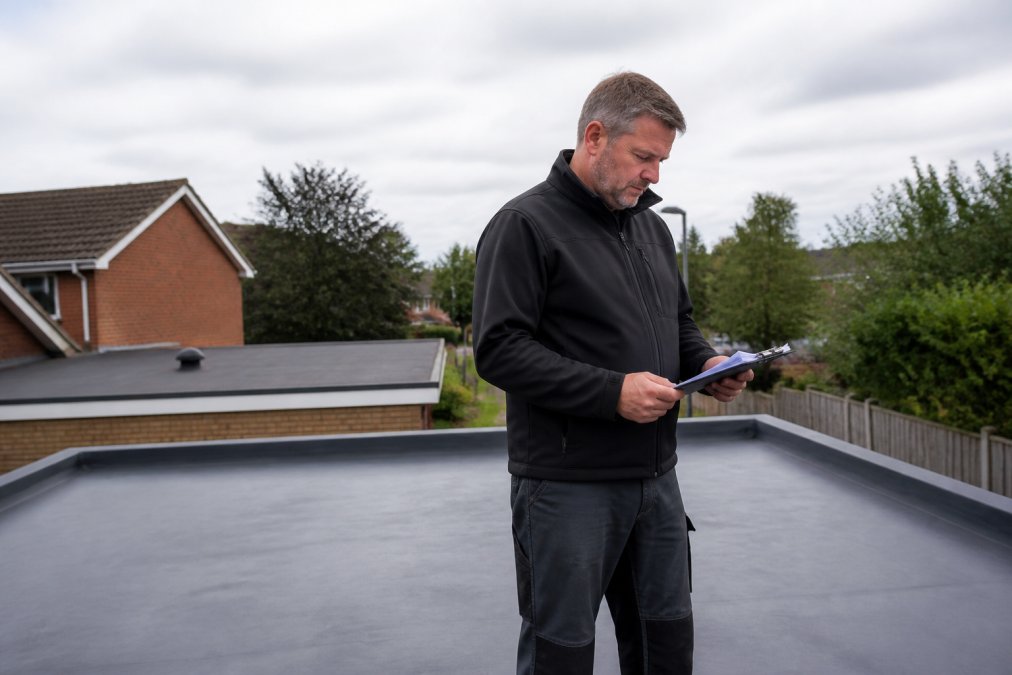
The scheme is not self-policing. Scheme operators conduct annual audits of registered contractors, reviewing installation quality, documentation practices, and ongoing technical competence. Contractors who fail audits are removed from the scheme register, which is publicly searchable.
Which Schemes Apply to Flat and EPDM Roofing Contractors
The COMPETENT ROOFER scheme register on the government's authorised schemes list is the primary route for specialist roofing contractors. NAPIT also operates a scheme that covers some roofing work where it intersects with other building fabric work. For EPDM rubber roofing specifically, contractors should hold membership of a scheme that covers flat roofing and be able to demonstrate that their scheme registration is current.
NVQ Levels, CSCS Cards and Trade-Specific Roofing Certification
Vocational qualifications and site safety cards are the two pillars of trade-specific roofing certification. An NVQ in roofing occupations demonstrates that a contractor has been assessed against national occupational standards for their specific trade. The relevant qualifications sit at Level 2 (operative level) and Level 3 (supervisory or advanced level). An NVQ is evidence of technical competence; it is not a site access pass.
CSCS Card Requirements for Site Workers
The CSCS card (Construction Skills Certification Scheme) is the site safety card that most principal contractors and site managers require before allowing any worker onto a construction site. For roofing operatives, the relevant card is the Blue CSCS Card (Skilled Worker), which requires the holder to hold a relevant NVQ Level 2 qualification or equivalent. Supervisory roofers typically need the Gold CSCS Card (Supervisory), which requires NVQ Level 3 or equivalent. As outlined by the Construction Industry Training Board's skills and qualifications guidance, mandatory training requirements include Health and Safety awareness testing as a prerequisite for any CSCS card application.
For domestic roofing work on private residential properties, CSCS cards are not legally required in the same way as on managed construction sites. However, a roofer who holds a current CSCS card has demonstrably met a minimum standard of health and safety awareness.
| Qualification | Level | What It Shows | Relevant For |
|---|---|---|---|
| NVQ Roofing Occupations | Level 2 | Operative competence | Residential and commercial installs |
| NVQ Roofing Occupations | Level 3 | Supervisory competence | Site management roles |
| Blue CSCS Card | Skilled Worker | Site safety awareness | Managed construction sites |
| Gold CSCS Card | Supervisory | Advanced safety knowledge | Site supervisors |
| Competent Person Scheme | Varies | Self-certification authority | Building Regulations compliance |
The Building Safety Act and Its Impact on Residential Roofing
The Building Safety Act 2022 changed the regulatory landscape for higher-risk buildings. For most residential flat roofing work on houses, garages, and single-storey extensions, the Act does not directly change the day-to-day compliance process. The Act's most significant provisions apply to higher-risk buildings, defined as buildings over 18 metres or 7 storeys that contain at least two residential units.
However, the Act has had two indirect effects that matter for residential property owners. The first is an increased emphasis on the "golden thread" of information: the principle that compliance documentation must be created, maintained, and transferred throughout the life of a building. For roofing work, this means the completion certificate, the Part L calculation, the fire classification documentation, and the warranty information should all be retained by the property owner and passed on at the point of sale.
The second effect is a cultural shift in how building control bodies and scheme operators approach audit and enforcement. The standard of compliance documentation expected from roofing contractors has risen, even for straightforward residential work.
How to Verify Roofer Qualifications Before You Hire
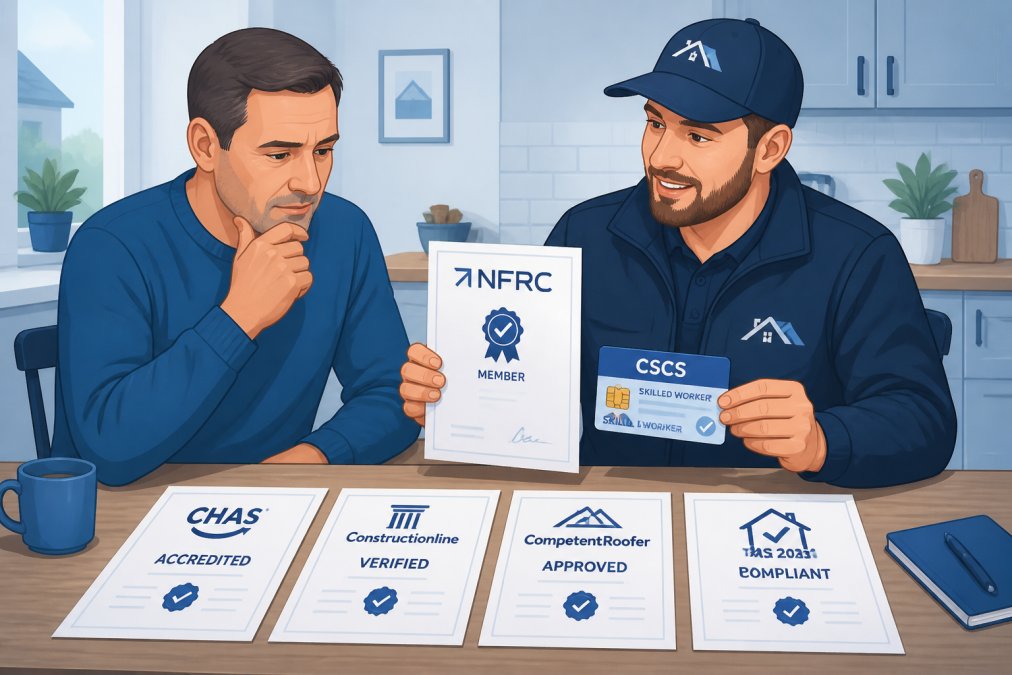
The most reliable way to verify a roofer's qualifications is to check primary sources directly, rather than relying on what the contractor tells you. Start with the competent person scheme register. The government maintains a publicly searchable list of all authorised schemes and their registered members. Enter the contractor's company name or registration number and confirm that their membership is current and covers the type of work they are proposing to carry out.
Next, ask for their public liability insurance certificate and confirm that roofing work is explicitly covered.
Insurance Implications of Hiring an Uncertified Roofer
Hiring an uncertified roofer carries insurance consequences that most homeowners do not discover until they need to make a claim. Many buildings insurance policies require that structural or building envelope work is carried out by a competent person and that appropriate building regulations approval has been obtained. If a claim arises from a roof installed without certification, the insurer may decline to pay on the grounds that the policy conditions were not met. A failed flat roof that allows water ingress can cause tens of thousands of pounds of damage. If the insurer declines the claim because the roof was installed by an uncertified contractor, the entire cost falls to the homeowner. The solution is straightforward: ask for the completion certificate before you make the final payment.
Digital Compliance Tracking and Compliance Documentation
Digital compliance tracking is changing what good practice looks like for both contractors and property owners. Several competent person scheme operators now issue digital certificates that are stored on a central register and can be accessed by homeowners, solicitors, and insurers via a unique reference number. This removes the risk of paper certificates being lost and makes compliance verification faster for everyone involved. Ask your contractor whether their scheme issues digital certificates and, if so, to provide you with the reference number on completion.
Waste Management and Environmental Obligations for Roofers
Roofing contractors generate significant volumes of waste: old membrane, insulation board, battens, fascia and soffit material, and packaging. Under the Environmental Protection Act 1990 and the Duty of Care Regulations, anyone who produces, carries, or disposes of controlled waste has a legal duty of care to ensure it is handled correctly. For roofing contractors, this means waste must be transferred only to a licensed waste carrier, and the contractor must obtain a waste transfer note for every load. As set out in the Environment Agency's guidance on waste duty of care, these transfer notes must be retained for at least two years and produced on request.
Ask your contractor to confirm they hold a registered waste carrier licence and that they will provide you with copies of the waste transfer notes for all materials removed from your property. A contractor who cannot or will not provide this is operating outside the law. Some flat roofing materials, particularly older built-up felt systems, may require specialist disposal. A competent contractor will identify this during the survey stage and factor appropriate disposal costs into the quotation.
Frequently Asked Questions
What certification does a professional roofer need in the UK?
There is no single mandatory licence for roofing in the UK, but professional roofers are expected to hold relevant NVQ qualifications (typically Level 2 or Level 3 in Roofing Occupations), a valid CSCS card, and membership of a recognised competent person scheme such as NFRC or Competent Roofer. These credentials demonstrate technical competence and allow contractors to self-certify certain work under Building Regulations without a separate local authority application.
Can a roofer self-certify their work under Building Regulations?
Yes, provided the contractor is registered with an approved competent person scheme covering roofing work. Schemes such as Competent Roofer and NFRC membership allow registered contractors to self-certify notifiable work, including flat roof replacements, without submitting a full Building Regulations application to the local building control authority. The scheme issues a compliance certificate on completion, which you should retain for your property records and any future sale.
How do I check if my roofer is registered with a competent person scheme?
Ask the contractor for their scheme membership number and verify it directly on the relevant scheme's online register. The government's own competent person scheme portal lists all approved operators. For roofing, check the Competent Roofer register or the NFRC member directory. You can also request to see their CSCS card, NVQ certificates, and public liability insurance documents before any work begins. A reputable contractor will provide these without hesitation.
What impact does the Building Safety Act have on residential roofing?
The Building Safety Act 2022 raised accountability standards across the construction industry, including roofing. While its most stringent requirements target higher-risk buildings, the Act strengthens the duty on all contractors to demonstrate technical competence and maintain accurate compliance documentation. For residential roofing, this means clearer obligations around notifying building control, retaining records of materials used, and ensuring work meets current installation standards. Homeowners can now more readily hold contractors accountable for defective work.
Flat roofing work that falls short of current certification standards creates problems that compound over time: insurance disputes, building control enforcement, and costly remediation. ARRC Ltd brings over 30 years of experience to every installation, with full compliance documentation, competent person scheme certification, and a 20-year guarantee on flat rubber roofs. Get a quote from ARRC Ltd and have your roofing work done once, correctly, with every certificate in place.
This article was written using GrandRanker